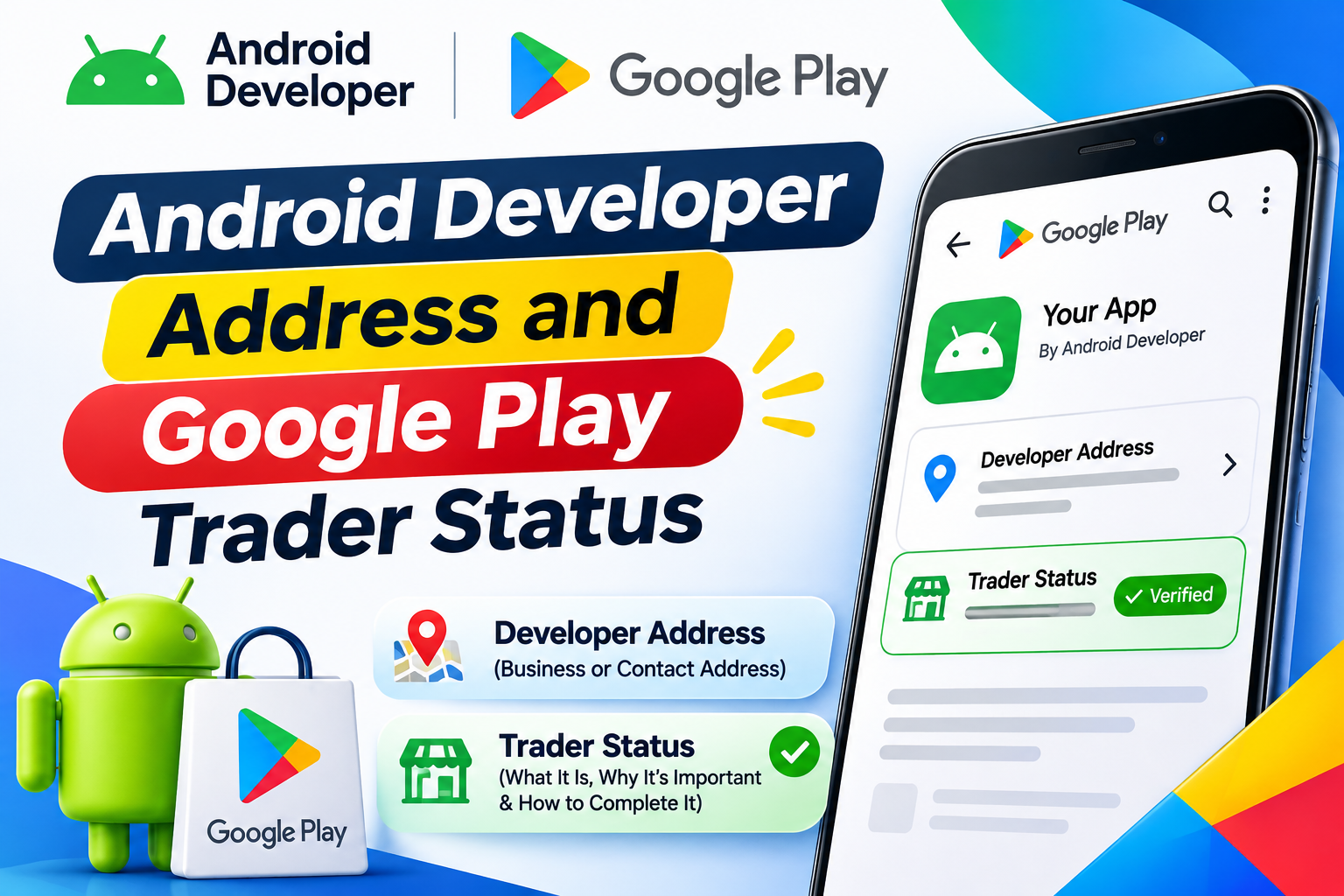
For an independent app maker, reaching users in Europe may come with a privacy cost that extends well beyond Europe. The Android developer address associated with a business can be an office or a service address. For someone working alone, it may also be the place they live.
The Verge reports that Google is changing its disclosure requirements to meet the EU Digital Services Act, but plans to show affected developers’ contact details worldwide. That distinction matters: a rule intended to help users identify commercial sellers in a particular market could lead to personal information being visible far outside it.
The decision centers on Google Play trader status. According to The Verge, developers have until February 1, 2027, to declare whether they are a trader under UK and European law. Google broadly describes the category as applying to developers who earn revenue from their apps, particularly when that income is regular or high-volume. The report says hobby or non-commercial apps are exempt, as are developers who do not publish in the UK or Europe.
For those who declare themselves traders, The Verge says public disclosure of contact details, including an address and phone number, starts March 1, 2027. Developers without an office may face a difficult choice: disclose a home address, pay for a registered agent or another business-address service, or reconsider reaching those markets. The report does not provide a general price for those services, so the financial cost will depend on the option a developer chooses.
Google’s approach is not the only way to handle the issue. The Verge reports that Apple limits the display of developer addresses to the relevant European countries and accepts PO box addresses when developers provide documentation linking the box to their regular address. Google does not accept PO boxes for developer payment profile addresses, the report says.
The broader question is how much information a platform needs to make public, and to whom, when it verifies a commercial developer. For a related look at the risks surrounding personal information online, see our coverage of Character.AI chat privacy.
Google Play Trader Status: Who Needs to Declare and When?
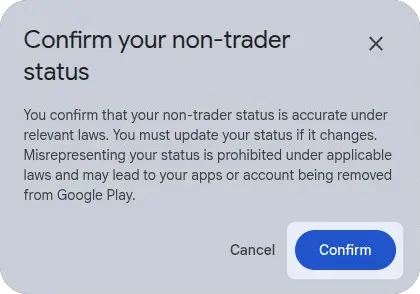
Developers distributing apps in the UK or Europe face a declaration deadline before any address is made public. According to The Verge’s report on Google’s policy, they have until February 1, 2027, to declare whether they are a trader under UK and European law. The question matters because Google Play trader status determines whether the contact-disclosure requirement described in the report applies.
Google’s description, as reported by The Verge, is broad: earning revenue from apps may make a developer a trader, particularly when that income is regular or generated at high volume. That does not mean every payment automatically settles the legal question. The report does not provide a revenue threshold or a complete legal test, so developers should not treat “earning money” alone as a definitive classification.
The Verge reports exemptions for developers whose apps are solely a hobby or non-commercial, as well as for those who do not publish in the UK or Europe. Those distinctions make both the nature of the app activity and its distribution important:
- Revenue-generating apps: Regular or high-volume earnings are signals Google highlights, but the report does not specify a minimum amount.
- Hobby or non-commercial apps: The report identifies these as exempt; it does not give a detailed test for borderline cases.
- Apps not published in the UK or Europe: The report says their developers are exempt from this requirement.
For developers who self-declare as traders, The Verge says Google will begin publicly sharing contact details, including a phone number and address, on March 1, 2027. The reported disclosure is worldwide, even though the policy change is intended to meet European regulations. Google does not accept PO boxes for developer payment profile addresses, according to the report, which makes the Android developer address question especially consequential for independent publishers working from home.
Developers should review their app’s commercial activity and distribution before declaring, and seek qualified advice if their circumstances are unclear. The report does not say what happens if someone misses the deadline or makes an incorrect declaration. For a related look at how platform decisions can affect personal information, see our coverage of Character.AI chat privacy.
What Android Developer Address and Contact Details Become Public?
For independent app makers, an Android developer address may soon be more than an account detail supplied to Google. Developers who declare themselves traders will have contact information, including an address and phone number, displayed publicly worldwide starting March 1, 2027, according to The Verge’s report.
The publication of those details is tied to European consumer transparency rules under the Digital Services Act. The practical question is how far the information travels: Google plans to make it visible worldwide, not just in the European markets that prompted the change. Someone outside Europe could therefore potentially access the same contact details as a European user.
Google Play trader status is an important distinction. The Verge reports that developers have until February 1, 2027, to declare whether they are traders under UK and European law. Google broadly describes the category as applying to developers who earn revenue from apps, particularly when that income is regular or substantial. The report says hobby or non-commercial apps are exempt, as are developers who do not publish in the UK or Europe.
For a company with an office, a public address may be an existing business contact point. For a solo developer working from home, it can carry a different privacy cost. The Verge reports that Google does not accept PO boxes for developer payment profile addresses. A developer without an office could therefore face a choice between exposing a home address and paying for a registered agent or another service that supplies a business address.
Public contact details could make unwanted messages or attempts to identify a developer’s home easier. Those are potential consequences, not incidents documented in the source story. A separate read on digital privacy risks explores another context in which control over personal information matters.
Apple’s approach shows that the same regulatory context does not necessarily produce the same visibility. According to The Verge, Apple displays developer addresses only in the relevant European countries and permits PO boxes when developers provide a receipt or bill connecting the box to their regular address. The report says Google had not explained why it chose worldwide publication or why PO boxes were not permitted when asked.
Android Developer Address Options for Independent Creators
For an independent creator, choosing an Android developer address can mean balancing privacy against the expense and administration of maintaining a separate business address. The decision matters most for developers who declare themselves traders and continue distributing apps in the UK or Europe.
According to The Verge’s report, Google plans to make traders’ addresses and phone numbers public worldwide. The report also says Google does not accept PO boxes for developer payment profile addresses. It does not establish why Google has that policy, or whether any particular address service will meet its requirements.
- Publish a home address: This avoids arranging a separate address, but puts a developer’s residential location in public view. The privacy trade-off can extend beyond the creator to other people living there. Before choosing this route, consider whether that exposure is acceptable and how you would handle contact from strangers.
- Investigate a registered agent or business-address service: The Verge identifies these services as a possible alternative for developers without an office. They may offer separation between work and home, but a developer should check the provider’s terms, what mail handling is included, and whether Google will accept the address for the relevant profile and public disclosure. The report does not provide prices or establish that every service is eligible.
- Consider office space: An office could provide a location distinct from home, but it also introduces a separate space to arrange and maintain. The Verge reports that one independent developer, speaking to The Elec, was considering renting a private office solely to comply. That example illustrates the possible burden; it does not establish what an office would cost or whether renting one is necessary.
Before committing to any option, review your Google Play trader status and the current instructions for your account. The Verge reports a February 1, 2027 deadline to declare status and a March 1 start for public disclosure. It also reports exemptions for hobby or noncommercial apps and developers who do not publish in the UK or Europe. Those choices have their own reach and revenue implications.
For a related perspective on managing personal information online, read our discussion of Character.AI chat privacy and data risks.
Google Play Trader Status vs. Apple’s Approach
The same European regulations can lead to different privacy outcomes depending on how an app store implements them. According to The Verge’s reporting on developer address disclosure, Google and Apple are taking notably different approaches to where an address appears and whether a PO box can be used.
Visibility is the first distinction. Apple displays developer addresses only in relevant European countries, the report says. Google plans to make the contact details of developers who declare themselves traders public worldwide. For an independent developer using a home address, that difference affects who can see the information: disclosure would extend beyond the European markets that prompted the policy.
Address options are the second distinction. Apple accepts a PO box if the developer provides a receipt or bill linking it to their regular address. That gives qualifying developers a way to supply an address without necessarily displaying their home location. Google, by contrast, does not accept PO boxes for developer payment profile addresses, according to The Verge.
That does not mean every affected Android developer must publish a home address. The report identifies a registered agent or another service providing a business address as an alternative. Such a service introduces a potential cost, however, and the story does not provide a typical price. Developers without an office therefore face a trade-off between privacy and the expense of obtaining another usable address.
Google Play trader status also depends on the developer’s circumstances. The Verge reports that developers have until February 1, 2027, to declare whether they are traders under UK and European law. Google broadly associates that classification with earning app revenue, particularly when it is regular or high-volume. Hobby or noncommercial apps are exempt, as are developers who do not publish in the UK or Europe. The reported public disclosure of traders’ contact details, including an address and phone number, begins March 1, 2027.
The important distinction is between the regulation and Google’s chosen implementation: the report does not establish that the law requires worldwide publication or Google’s particular PO box restriction. Developers weighing an Android developer address should consider both the audience for disclosure and their available address options. For a related look at personal information risks, read our coverage of Character.AI chat privacy.
A Google Play Trader Status Decision Checklist
Choosing an Android developer address is not just an administrative task: it can determine which contact details are visible to people around the world. Before making a Google Play trader status declaration, work through the following questions and verify the current requirements for your account.
- Where are your apps available? Review the countries where each app is published, including any markets you enabled when setting up distribution. According to The Verge’s report on Google’s policy, developers who do not publish in the UK or Europe are exempt from the trader requirement described in its story. If reaching those users matters to your business, weigh that benefit against the disclosure implications before changing distribution.
- Is your activity commercial? The Verge reports that Google broadly considers app revenue relevant, particularly when earnings are regular or high-volume. The story says hobby and non-commercial apps are exempt. A developer with mixed projects or uncertain revenue should not assume that a label alone settles the question; review Google’s current guidance and seek professional advice if the facts are unclear.
- When must you declare? The Verge gives February 1, 2027, as the deadline for developers to declare whether they are traders under UK and European law. It also reports that public disclosure of traders’ contact details, including an address and phone number, is scheduled to begin on March 1. Check your Play Console and current platform guidance for the applicable instructions and any changes.
- Which address options are acceptable? The Verge says Google does not accept PO boxes for developer payment profile addresses. It identifies a registered agent or another business-address service as possible alternatives for developers without an office, but does not establish that every service will meet Google’s requirements. Confirm eligibility and costs before paying or submitting an address.
- What will disclosure mean for you? The Verge reports that Google plans to make the contact details public worldwide. Consider whether an address is also your home, whether someone can reliably receive correspondence there, and whether a phone number is suitable for public contact.
The Verge asked Google why PO boxes were not permitted and why details would be shared globally; the supplied story reported no response. Until those questions are clarified, avoid treating an unverified address arrangement as a solution. For a related look at personal-data exposure, see our coverage of AI prompt privacy and hidden data risks.
Conclusion: Android Developer Address Key Takeaways
The Android developer address requirement turns a routine compliance decision into a privacy question for independent app makers. According to The Verge’s report on Google’s policy change, developers have until February 1, 2027, to declare whether they are traders under UK and European law. For those who declare themselves traders, Google will begin publicly sharing contact details, including an address and phone number, on March 1.
Google Play trader status is especially relevant to developers who earn money from their apps. Google’s guidance, as described in the report, broadly associates trader status with revenue, particularly when earnings are regular or substantial. Hobby and noncommercial apps are exempt, as are developers who do not publish in the UK or Europe. Developers should assess their own circumstances rather than assume that every app or every source of income is treated alike.
- Visibility extends beyond Europe. Although the policy is intended to meet European regulatory requirements, Google says the contact details will be public worldwide. A developer’s decision to reach European users can therefore have a broader privacy impact.
- A home address may be at stake. Google does not accept PO boxes for developer payment profile addresses. Someone without an office may need to consider publishing a home address or paying for a registered agent or another business-address service.
- Apple takes a different approach. The Verge reports that Apple displays developer addresses only in the relevant European countries and permits a PO box when the developer provides a receipt or bill linking it to their regular address.
The comparison matters because both companies face the same regulations, yet their approaches differ on where addresses appear and whether a PO box is an option. The report does not establish why Google chose worldwide display or excludes PO boxes, so developers should not treat either choice as a demonstrated legal necessity.
For an independent developer, the practical decision is to weigh European market access against the exposure and potential cost of a suitable address. Check the applicable declaration requirements and address options before the deadlines. For a separate look at how information can travel beyond its expected setting, see our related coverage of AI prompt privacy and the AI supply chain; the technology and risks differ, but the broader concern about data visibility is relevant.