
Can a machine really help you beat the odds? This question is on the minds of many sports and eSports enthusiasts as artificial intelligence continues to transform the way we approach betting.
From advanced analytics in professional leagues to AI-powered predictions in betting apps, technology is now being leveraged to process vast amounts of data in ways humans simply cannot match.
But while AI may sound like a magic tool for winning bets, the reality is more nuanced.
The rise of AI in betting has been remarkable.
In sports like football, basketball, and even tennis, machine learning algorithms can analyze thousands of historical matches, player stats, team performance trends, and even external factors like weather conditions to generate probabilities for different outcomes.
Similarly, in the eSports arena, AI is used to study player performance patterns, in-game strategies, and tournament histories to make predictions that would take humans days, if not weeks, to compute.
Betting apps have started integrating these AI tools to provide users with data-driven insights and suggested bets, making it easier for casual and professional bettors to access complex analytics at their fingertips.
So, can you use AI to predict bets effectively? The short answer is yes — but with important caveats. AI can improve decision-making by highlighting patterns and trends that may not be obvious to human bettors.
For example, a machine learning model might identify a football team’s tendency to score more in away games under certain conditions, allowing bettors to make more informed wagers.
However, AI is not a crystal ball. Sports remain inherently unpredictable, and even the most sophisticated algorithms cannot account for sudden injuries, unexpected referee decisions, or random upsets.
Understanding the limitations and risks is crucial. Smart bettors use AI as a supportive tool rather than a guaranteed path to profit.
By combining AI-generated insights with careful bankroll management, trend analysis, and human judgment, you can significantly improve your chances of making informed bets while avoiding reckless decisions.
Ultimately, the question “Can you use AI to predict bets?” doesn’t have a simple yes or no answer.
AI can provide a powerful edge, but winning consistently still depends on strategy, discipline, and an understanding that risk can never be fully eliminated.
More Read: How to Up My Unearther Level Fast: Smart Strategies for Quick Progress
Why AI Feels Like a Game-Changer in Betting
In the fast-paced world of betting, speed and accuracy are everything—and that’s where AI truly shines. Unlike humans, who can only process limited data at a time, AI can analyze thousands of games in seconds.

This massive processing power allows it to spot trends and patterns across entire leagues, seasons, and even player careers, something that would take a human weeks—or even months—to calculate.
One of the most significant advantages of AI in betting is its ability to remove emotional bias. Human bettors often make decisions based on gut feelings, loyalty to a favorite team, or recent wins and losses.
These emotions can lead to impulsive or irrational bets. AI, on the other hand, focuses purely on the numbers. It evaluates probabilities and patterns without letting personal bias or excitement influence its predictions, helping bettors make decisions that are data-driven rather than emotional.
AI also excels at detecting hidden opportunities that humans might easily overlook. For instance, it can identify underdog teams that consistently outperform expectations under certain conditions, or players who perform exceptionally well in specific matchups.
This ability to uncover subtle patterns can give bettors a unique edge. For example, an AI model might predict that a lesser-known football team has a 35% higher chance of winning in away games based on historical data—information that a casual bettor might never notice.
These capabilities make AI a powerful tool for anyone looking to make smarter bets. By processing massive amounts of data quickly, removing emotional bias, and highlighting hidden trends, AI offers insights that can significantly improve decision-making.
While it’s not a guarantee for winning every bet, it can certainly help bettors approach wagering with a more informed, strategic mindset.
So, if you’re wondering “Can you use AI to predict bets?”, the answer is yes—AI can process data, identify opportunities, and reduce human error, giving you a smarter way to analyze games and make decisions.
More Read: What Is Content at Scale? Strategy, Benefits, and Implementation Guide
How AI Actually Works in Betting
AI has transformed the way betting decisions are made by leveraging advanced data analysis in ways humans simply can’t match.
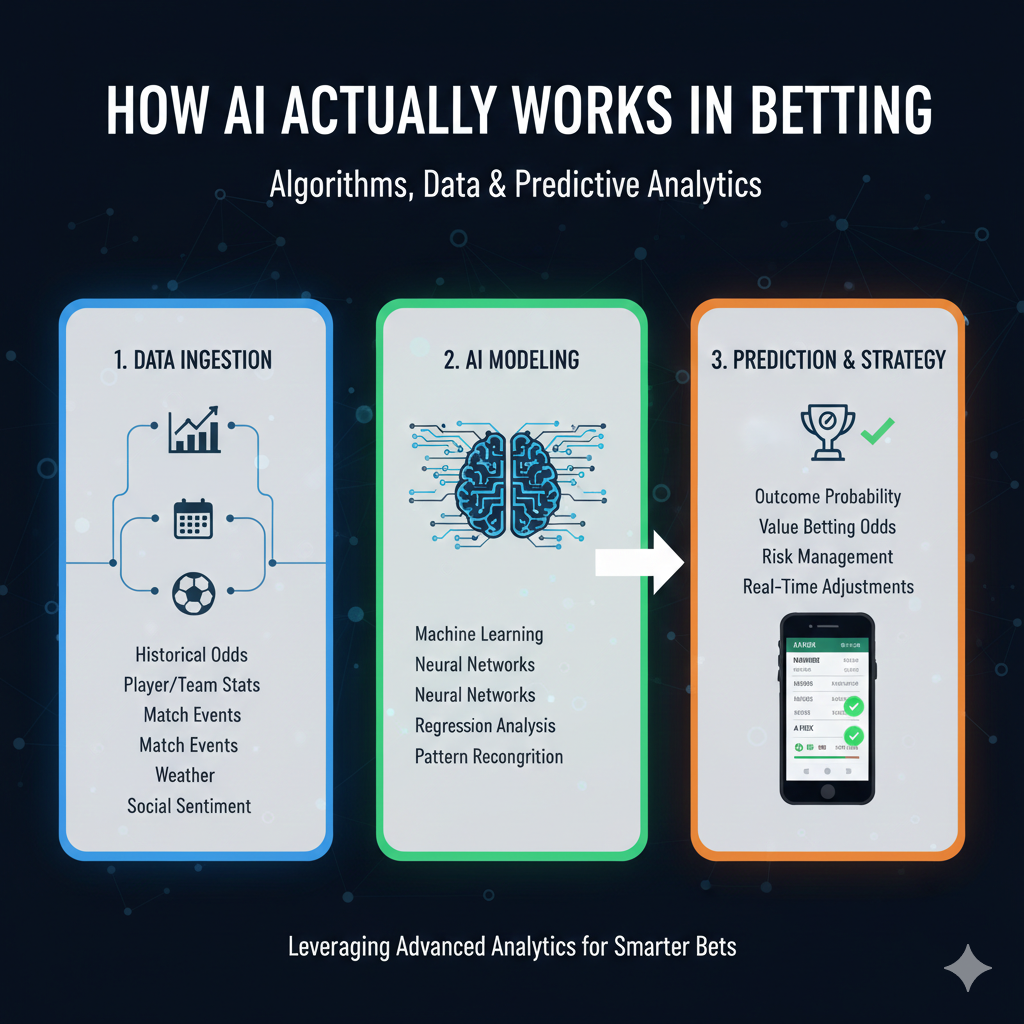
At its core, AI begins with collecting massive amounts of historical data. This includes player statistics, team performance over seasons, head-to-head match outcomes, and even contextual factors like home or away performance.
By building this comprehensive dataset, AI creates a foundation that allows it to identify trends and patterns that might otherwise go unnoticed.
Once the data is collected, machine learning algorithms come into play. These algorithms analyze past results to calculate probabilities for different outcomes.
For example, an AI model might detect that a particular basketball player performs significantly better against certain defensive setups or that a soccer team has a higher chance of scoring in the last 15 minutes of a game.
These insights are derived purely from patterns in the data, not guesses, giving bettors a statistically informed view of potential outcomes.
A key strength of AI is its ability to continuously learn and improve. Each new match, performance metric, or injury report adds more data for the algorithm to process.
Over time, this constant learning helps refine predictions, making them more accurate as the AI adapts to evolving trends.
In other words, AI doesn’t just rely on static historical data—it updates its models dynamically, incorporating fresh information to adjust probabilities in real time.
Real-time applications make AI even more valuable in modern betting. It can instantly factor in odds adjustments, last-minute injury reports, or even weather conditions that could influence a game’s outcome.
For example, a football match played in heavy rain may favor a strong defense over an attacking team—a detail AI can integrate into its predictions faster than any human analyst.
So, can you use AI to predict bets? Absolutely. By collecting historical data, identifying patterns with machine learning, and continuously improving through real-time updates, AI provides bettors with insights that are both comprehensive and actionable.
While it’s not a guaranteed winning formula, it gives a significant edge by turning raw data into meaningful, informed predictions.
The Reality Check: Can AI Guarantee Wins?
While AI offers impressive tools for analyzing data and spotting trends, it’s important to remember that it predicts probabilities, not certainties.
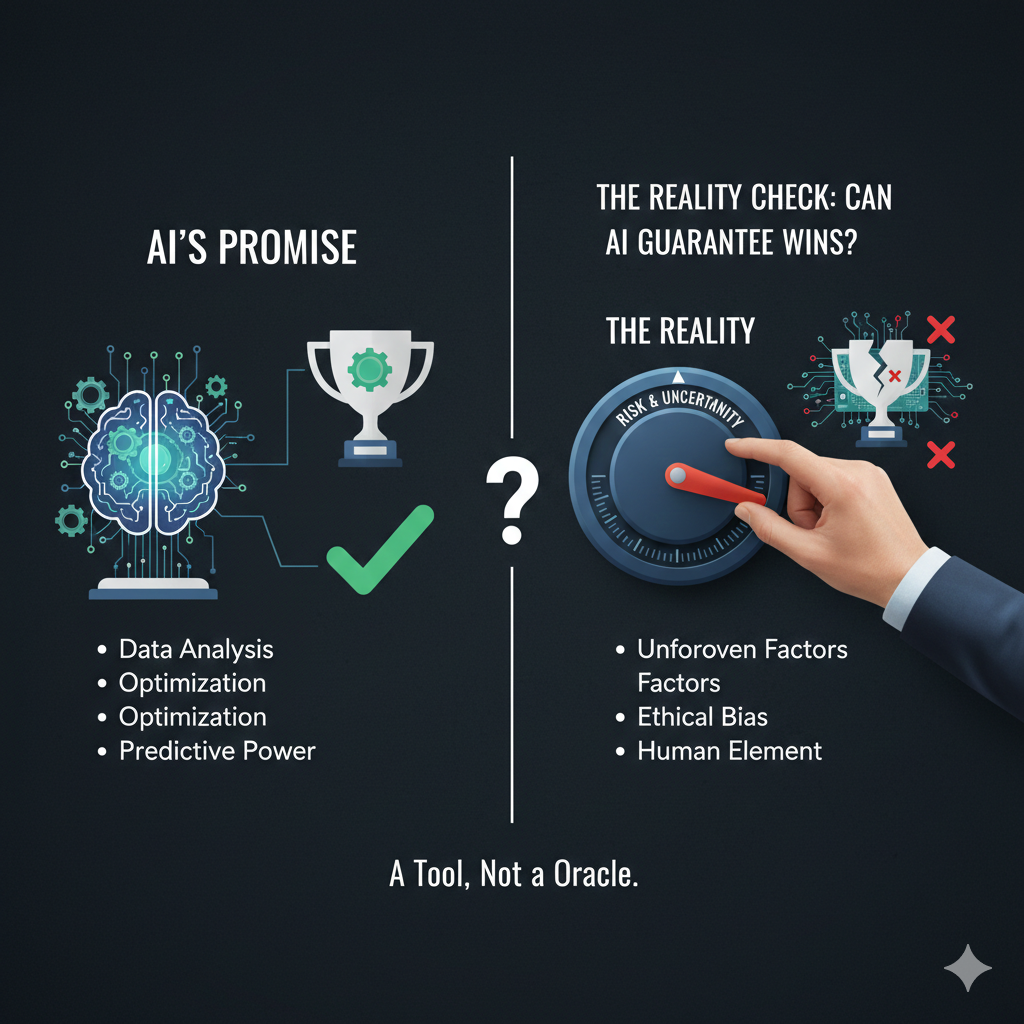
No matter how sophisticated an algorithm may be, it cannot guarantee outcomes because sports are inherently unpredictable.
Injuries, referee decisions, sudden weather changes, or unexpected upsets can all derail even the most statistically likely results.
For instance, a heavily favored team could lose a match due to a key player getting injured in the first half—a factor that even the most advanced AI might not fully account for in real time.
Even the best AI models are subject to randomness and the principle of market efficiency. Sports betting markets are highly competitive, and odds often already reflect much of the available data.
This means that while AI can identify small edges, it cannot consistently exploit them without risk. In practice, this translates to AI helping you make more informed decisions, but it cannot create a “sure thing.” Bettors who expect guaranteed wins are likely to be disappointed.
Adding another layer of complexity, bookmakers themselves employ AI and advanced algorithms to adjust odds dynamically.
This means that as soon as AI models detect trends or potential outcomes, the market responds by shifting odds, which reduces the potential edge a bettor might have.
Essentially, you are competing in a high-tech environment where both sides—bettors and bookmakers—are using similar predictive tools.
So, can you use AI to predict bets? Yes, but with caution.
AI can give you a better understanding of probabilities and trends, and it can highlight potential opportunities, but it cannot eliminate risk or make sports outcomes predictable.
Successful bettors use AI as a supportive tool, combining it with strategy, discipline, and careful bankroll management to make smarter wagers.
Ultimately, AI in betting is like having a high-powered microscope: it helps you see patterns you might miss, but it cannot control the game itself. Understanding its limitations is key to using it effectively and responsibly.
Where AI Can Actually Help You Win Smarter
AI may not guarantee wins, but it can be a powerful tool to help bettors make smarter, more informed decisions.
One of its key strengths lies in identifying value bets—situations where the odds offered by bookmakers are higher than the actual probability of an outcome occurring.
For example, if a football team has a 40% chance of winning according to AI analysis, but the sportsbook’s odds suggest only a 30% chance, that bet represents potential value.
Spotting these opportunities consistently can give bettors an edge over time.
Another way AI helps is by tracking long-term trends. Sports outcomes are often influenced by subtle patterns that are difficult for humans to detect.
AI can analyze seasons of data, including team form, player performance under specific conditions, and even head-to-head statistics, to provide a data-backed perspective.
This approach allows bettors to move away from impulsive decisions and instead rely on probabilities and trends when placing wagers.
AI also supports consistency and discipline in betting strategies. One common pitfall for human bettors is chasing losses or making emotionally-driven decisions after a bad streak.
By providing objective, data-driven recommendations, AI helps maintain a steady approach. Bettors can develop a clear plan, stick to pre-determined risk levels, and avoid the psychological traps that often lead to bigger losses.
Reducing emotional decisions is another critical advantage. Humans are naturally influenced by recent results, biases toward favorite teams, or gut feelings.
AI removes this emotional element entirely. It evaluates each betting opportunity solely based on historical data, current performance, and statistical probabilities.
This detachment can prevent impulsive betting, keeping decision-making rational and disciplined.
So, can you use AI to predict bets effectively? Yes. While it cannot control randomness or guarantee outcomes, AI can help you identify value bets, track trends, improve strategy consistency, and minimize emotional decisions.
Used wisely, it becomes a tool that complements human judgment, helping bettors approach wagering with a more informed and strategic mindset rather than relying on luck alone.
Common Mistakes Bettors Make with AI
Even with all the advantages AI brings to betting, there are important pitfalls that bettors need to avoid. One of the most common mistakes is blindly following AI predictions without understanding them.
AI can provide probabilities and trend insights, but it doesn’t replace human judgment. Relying solely on the numbers without knowing why a prediction was made can lead to poor decisions, especially when unexpected events occur in a game.
Another trap is expecting guaranteed wins or quick profits. Many people are drawn to AI betting tools with the hope of beating the odds instantly. In reality, even the most sophisticated AI can only give probabilities, not certainties.
Sports outcomes are unpredictable, and chasing the illusion of a “sure thing” often leads to losses rather than profits.
Ignoring bankroll and risk management principles is another frequent error. AI can suggest opportunities, but without proper money management, even small losses can compound quickly.
Successful bettors use AI as a tool to make informed decisions while maintaining strict control over their wagers, ensuring that one bad bet doesn’t derail their entire strategy.
Lastly, some bettors fall into the trap of overloading on too much data without focusing on actionable insights. AI can analyze vast datasets—player stats, team performance, historical trends—but not all information is relevant for every bet.
Getting lost in unnecessary details can lead to indecision or placing bets that aren’t statistically advantageous. The key is to use AI to highlight meaningful patterns and trends, then act strategically based on those insights.
So, can you use AI to predict bets? Yes, but with caution. It’s a powerful tool, but only when combined with understanding, discipline, and a clear betting strategy.
Avoid these common mistakes, focus on the actionable insights AI provides, and remember that probability does not equal certainty.
Using AI wisely transforms it from a flashy tech gadget into a practical ally for smarter, more informed betting.
Tips for Using AI Effectively in Betting
Using AI effectively in betting is less about finding a magic formula and more about using it as a smart research tool.
One of the most important principles is to treat AI as a guide, not an autopilot. While AI can process huge amounts of data and identify trends that humans might miss, it doesn’t understand context or sudden events like a key player’s injury or a last-minute lineup change.
Bettors who rely solely on AI without applying judgment risk making poor decisions.
A smarter approach is to combine AI insights with human intuition. For example, AI might flag an underdog team as a potential value bet based on historical patterns.
A human bettor can then weigh additional factors—such as current team morale, recent transfers, or coaching changes—that the AI might not fully capture.
This combination of data-driven analysis and human insight creates a balanced, informed strategy.
It’s also crucial to track your performance over time. AI predictions are only useful if you monitor results and refine your approach based on experience.
By keeping records of your bets, noting which AI suggestions worked and which didn’t, you can adjust your strategy to focus on the types of opportunities where AI adds the most value.
This process of learning from results helps maximize the benefits of AI over the long term.
Finally, start small and test AI predictions before committing significant amounts of money. Treat early bets as experiments to understand how the AI performs in real scenarios.
This cautious approach helps you learn without risking large losses and ensures that AI becomes a tool for strategic improvement rather than a source of reckless decisions.
So, can you use AI to predict bets successfully? Yes—but the key is to use it wisely. By treating AI as a research assistant, combining its insights with human judgment, tracking performance, and starting small, bettors can make smarter, more informed decisions while managing risk.
AI isn’t a crystal ball, but when used thoughtfully, it can give you a measurable edge in the unpredictable world of sports betting.
Case Studies / Real-World Examples
AI has already made a significant impact across both traditional sports and eSports, offering new ways to analyze games and find advantages that were previously impossible.
In professional sports, analytics teams use AI to identify edges over the competition.
By processing thousands of matches, player statistics, and situational data, these teams can pinpoint subtle patterns—like a basketball player performing better against certain defensive setups or a soccer team’s scoring trends under specific conditions.
These insights inform not just team strategy, but also how bettors can spot opportunities that aren’t obvious from watching games alone.
In the fast-growing world of eSports, AI is equally transformative. Competitive gaming generates massive amounts of in-game data, from player movements and decision-making to team strategies and map control.
AI algorithms can analyze this information to predict match outcomes with remarkable speed and accuracy. For example, AI can identify a team’s tendency to favor aggressive early-game strategies, giving bettors insight into probable match results or potential upsets.
These tools are increasingly integrated into betting platforms, making advanced analytics accessible to everyday users.
Despite these advances, professional bettors caution that AI is helpful, but not magic. Even the most sophisticated systems can’t predict every outcome or control for randomness. Upsets, injuries, or unexpected tactical changes can always occur.
Successful bettors treat AI as a supportive tool, combining algorithmic insights with experience, intuition, and disciplined bankroll management.
They understand that AI provides an edge, not certainty, and that human judgment remains essential for interpreting the data and making smart wagering decisions.
So, can you use AI to predict bets effectively? Yes—AI can reveal patterns, highlight value opportunities, and process enormous datasets far faster than a human could.
But like any tool, its value depends on how it’s used.
Bettors who understand its limitations, integrate their own judgment, and approach wagering strategically can harness AI to make smarter, more informed decisions while avoiding the pitfalls of overreliance.
Ethics, Legal, and Responsible Betting
As AI becomes more prevalent in betting, it’s important to remember the legal and ethical boundaries that govern gambling.
Gambling laws vary widely across regions, and what’s permitted in one country may be restricted or even illegal in another.
For instance, some countries strictly regulate online sports betting, while others have licensed platforms that comply with local laws.
Bettors should always ensure that any AI tools or betting platforms they use are legally authorized in their jurisdiction to avoid fines or legal trouble.
Equally important is the principle of responsible betting.
AI can make betting more informed and data-driven, but it cannot remove risk or prevent losses. Setting limits on how much to wager, tracking losses, and avoiding chasing losses are essential strategies to protect both your finances and mental well-being.
Overreliance on AI predictions without discipline can lead to reckless behavior, which is a common pitfall for inexperienced bettors.
AI should be seen as a tool to enhance strategy, not as a way to bypass risk. Its purpose is to provide insights, highlight trends, and suggest potential opportunities—not to guarantee wins or encourage high-stakes gambling.
By combining AI predictions with human judgment, careful bankroll management, and self-imposed limits, bettors can enjoy a smarter, safer approach to wagering.
So, can you use AI to predict bets responsibly? Yes. But success depends not only on how well you interpret AI insights, but also on understanding the legal landscape and maintaining disciplined, responsible betting habits.
When used wisely, AI becomes a supportive partner that enhances your strategy while keeping risk under control.
The Future of AI in Betting
The future of AI in betting is already unfolding, with automated betting bots and predictive platforms leading the way.
These systems can place wagers based on real-time analysis of games, player performance, and odds, executing strategies faster than any human could.
For example, some bots can scan hundreds of matches, calculate probabilities, and place bets within seconds of detecting a potential value opportunity—giving users a speed advantage in highly competitive markets.
Meanwhile, AI-driven sportsbooks and real-time analytics are transforming how odds are set and adjusted. Bookmakers now use AI to analyze live game data, update probabilities instantly, and manage risk more efficiently.
For bettors, this means the market is more dynamic than ever, and access to AI-powered insights can help identify patterns or edge bets before the odds shift.
Real-time analytics also allow users to react quickly to in-game events, such as a sudden injury or change in team strategy, giving them a better chance to make informed wagers.
AI is also increasingly integrated into fantasy leagues and online betting apps. From projecting player performance to simulating match outcomes, these platforms use machine learning to give users data-driven recommendations for drafting teams or placing bets.
For example, an AI-powered fantasy app might suggest a player who historically performs better under specific match conditions, helping users optimize their lineups and betting decisions.
So, can you use AI to predict bets in this rapidly evolving environment? Absolutely. While it cannot guarantee wins, AI provides tools for smarter, faster, and more informed decision-making.
By leveraging automated bots, real-time analytics, and AI-driven platforms, bettors can gain an edge in both traditional sports betting and emerging digital formats.
The key is to use these technologies as supportive tools—combining algorithmic insights with human judgment, strategy, and discipline to maximize the benefits while minimizing risks.
Final Takeaway / Conclusion
In the end, the question “Can you use AI to predict bets?” doesn’t have a simple yes-or-no answer. AI can make betting smarter, faster, and far more data-driven than traditional methods.
By analyzing vast amounts of historical data, spotting trends, and calculating probabilities, AI gives bettors insights that would take humans weeks or months to uncover.
Whether it’s spotting value bets, tracking long-term trends, or processing real-time game updates, AI can certainly enhance the decision-making process.
However, winning consistently still requires more than just advanced algorithms. Strategy, discipline, and patience remain essential.
Even the most sophisticated AI cannot control randomness, injuries, or unexpected game events, and it cannot guarantee wins.
Professional bettors understand that AI is a tool for supporting decisions, not replacing judgment. The best results come from combining AI insights with human intuition, careful bankroll management, and a thoughtful approach to risk.
Treating AI responsibly is equally important. Bettors should start small, test predictions, and track results to see which strategies work best over time.
Overreliance or blind trust in AI predictions can lead to reckless decisions, while thoughtful use of these tools can enhance performance and reduce emotional bias.
AI should complement your strategy, not act as a magic solution promising guaranteed profits.
So, can you use AI to predict bets effectively? Yes—but the key is understanding its strengths and limitations.
Use AI to analyze data, uncover trends, and improve your betting strategy, while always maintaining discipline, monitoring results, and betting responsibly.
When approached correctly, AI becomes a powerful ally in the unpredictable world of sports and eSports betting, giving you a measurable edge without replacing the critical thinking that ultimately drives success.