Artificial intelligence is rapidly transforming how digital content is created, and AI video generators are one of the fastest-growing tools in this space.
Platforms that can turn simple text prompts into realistic videos are attracting creators, marketers, filmmakers, and social media users worldwide.
According to industry reports, the AI video generation market is expected to grow significantly in the coming years, driven by demand for faster content production and lower video creation costs.
Tools like OpenAI’s Sora, Runway, and other AI models have already shown how powerful text-to-video technology can be. Recently, another tool has gained massive attention online—Kling AI.
As Kling started trending on social media and tech forums in 2024, many users began asking a common question: “Is Kling a Chinese company?” This curiosity mainly comes from the growing influence of Chinese tech companies in the artificial intelligence sector.
China has heavily invested in AI development over the past decade, with government plans aiming to make the country a global AI leader.
Because Kling demonstrates advanced video generation capabilities similar to other cutting-edge AI tools, users naturally want to know who built it and where it originated.
The question “Is Kling a Chinese company?” is also linked to concerns about technology competition and data privacy. In recent years, people have become more aware of where digital tools come from and how user data may be handled.
When a new AI platform becomes popular, many users quickly search for information about its developers, ownership, and the country behind the technology.
That is why searches like “Is Kling a Chinese company?” have increased across search engines and tech discussion platforms.
In this article, we will clearly answer the question “Is Kling a Chinese company?” and explore the facts behind the AI platform.
You will learn what Kling AI is, which company developed it, when it was launched, and why it has quickly become one of the most talked-about AI video generators in the world.
By the end, you will have a clear understanding of Kling’s origin, ownership, and its growing role in the AI industry.
More Read: How to Up My Unearther Level Fast: Smart Strategies for Quick Progress
What Is Kling?
Kling AI is one of the newest and most advanced AI video generation tools gaining attention in the global technology industry.
Developed by the Beijing-based tech company Kuaishou, Kling AI was first introduced in June 2024 and quickly became known for producing highly realistic AI-generated videos.
The platform was created as part of the growing race among technology companies to develop powerful text-to-video AI models.
Similar to tools like OpenAI’s Sora or Runway, Kling allows users to create short videos simply by typing a description.
For example, a user can type a prompt such as “a golden retriever running on a beach at sunset”, and the AI will generate a realistic video based on that description.
Because the tool appeared suddenly with very advanced capabilities, many users began asking the same question online: “Is Kling a Chinese company?”.
The curiosity comes from the fact that Kling was built by Kuaishou, a major Chinese technology company known for its short-video platform with hundreds of millions of users.
Understanding how Kling works helps answer questions like “Is Kling a Chinese company?” and why the platform is becoming such a powerful competitor in the AI video market.
At its core, Kling AI is a generative AI model that converts text, images, or other inputs into video content.
Users provide prompts, and the system analyzes those instructions using deep learning models trained on large visual datasets.
The AI then generates frames, motion, lighting, and camera effects to create a coherent video sequence.
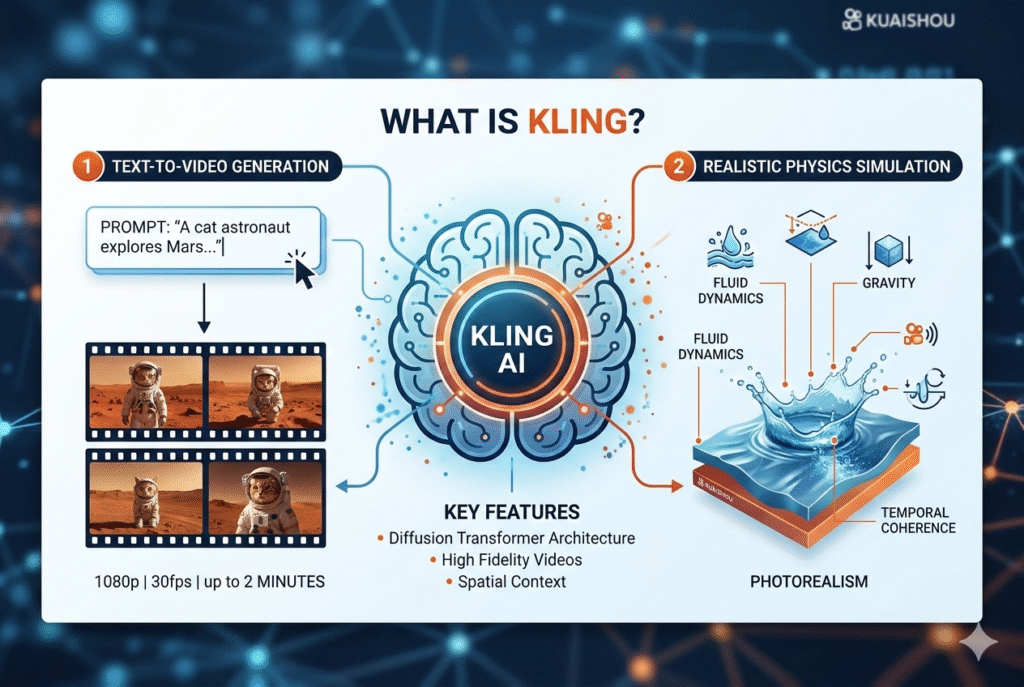
Kling can produce videos up to two minutes long at 1080p resolution and 30 frames per second, which is impressive for AI-generated content.
This level of quality has made people even more curious about the technology and its origin, leading many to search “Is Kling a Chinese company?” online.
One of the main reasons Kling is gaining popularity is its powerful feature set.
The most notable feature is text-to-video generation. Users simply describe a scene in natural language, and the AI creates a video that matches the prompt.
This allows creators, marketers, and filmmakers to generate content quickly without filming anything.
Kling can also convert static images into moving videos. For instance, a still photo of a landscape can be transformed into a dynamic clip with moving clouds, water, or people.
Another major strength is its ability to generate realistic motion and physics-based animation. Kling uses advanced AI architectures such as spatiotemporal attention models to simulate real-world movement like gravity, object interaction, and natural gestures.
These advanced capabilities explain why the question “Is Kling a Chinese company?” keeps appearing in search results.
The technology is powerful enough that many people want to know exactly who developed it and where it came from.
More Read: What Is Content at Scale? Strategy, Benefits, and Implementation Guide
Is Kling a Chinese Company?
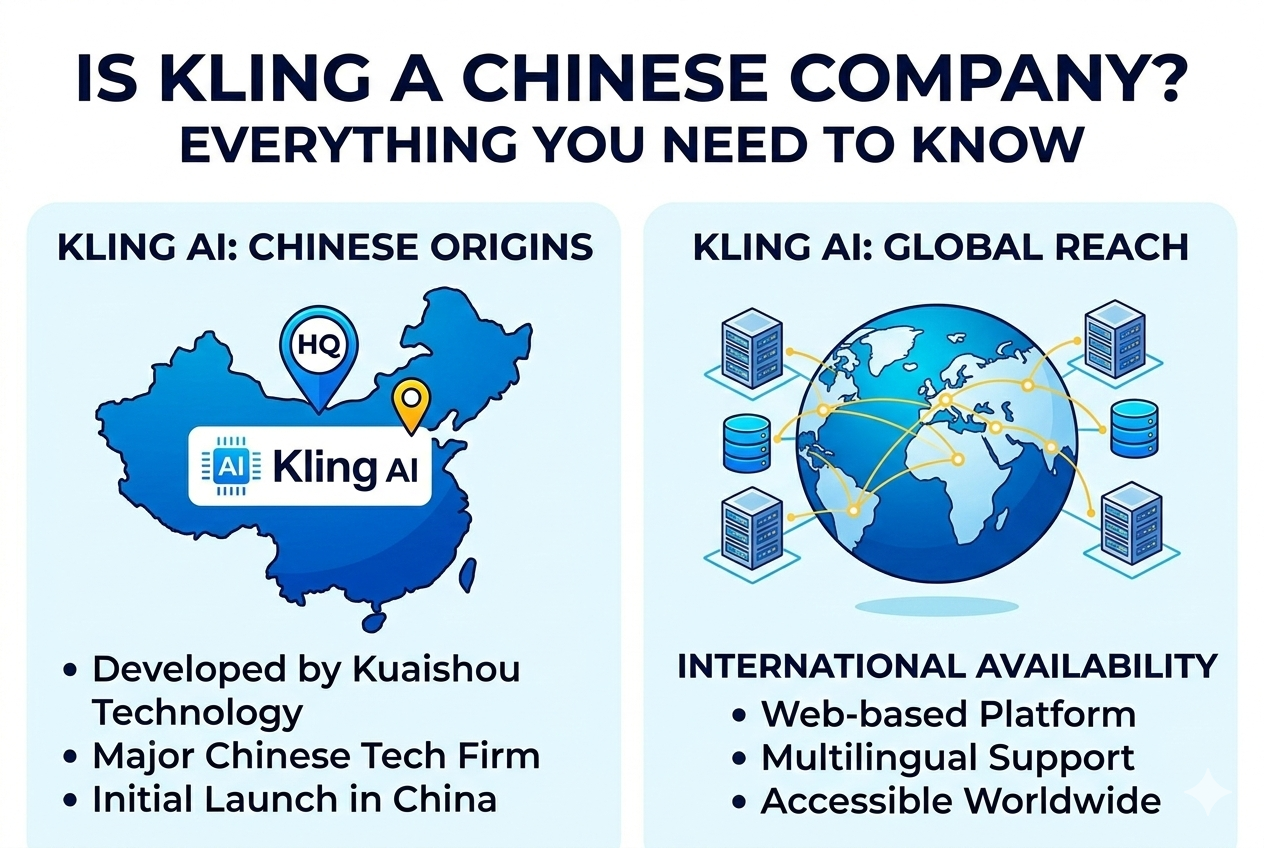
The short and clear answer is yes, Kling is a Chinese AI model.
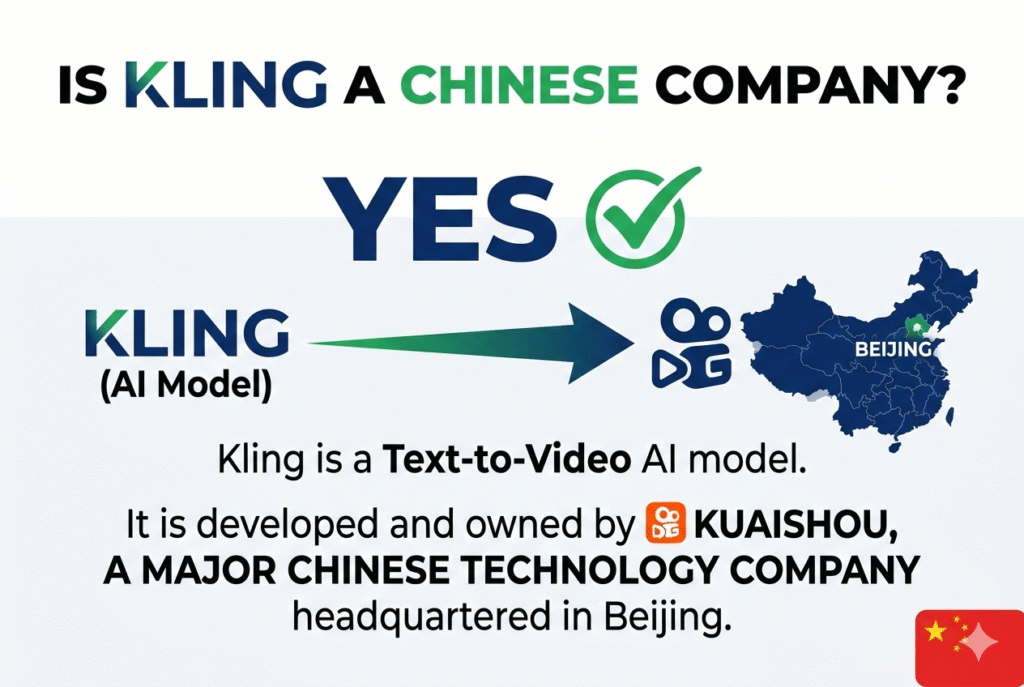
If you have been searching online and wondering “Is Kling a Chinese company?”, the answer lies in the organization that developed the technology.
Kling AI was created by Kuaishou Technology, a major Chinese internet company known for its short-video platform and artificial intelligence research.
Kling was officially introduced in June 2024 as part of Kuaishou’s push into advanced generative AI.
Soon after its launch, the tool attracted global attention because of its ability to generate high-quality videos from simple text prompts.
This rapid rise in popularity is exactly why many people started asking questions like “Is Kling a Chinese company?” and trying to learn more about the platform’s background.
Kling AI originated from the Kuaishou AI team, which has been working on artificial intelligence and computer vision technologies for several years.
The company developed Kling as a text-to-video generative AI model, designed to compete with other global AI tools such as OpenAI’s Sora and Runway’s video generation systems.
Kuaishou has a strong background in video technology because its main platform focuses on short-form video content.
The app has hundreds of millions of daily active users, giving the company extensive experience in video processing, recommendation algorithms, and AI-driven media creation.
This experience played a major role in the development of Kling.
Because the technology is highly advanced, many people across tech communities continue to ask “Is Kling a Chinese company?” to understand who built the system and where the innovation comes from.
Kling was developed in China, specifically by engineers and researchers working in Beijing. China has been investing heavily in artificial intelligence research over the past decade.
In fact, the Chinese government announced plans to become a global leader in AI technology by 2030, encouraging companies and universities to build powerful AI models.
This national focus on AI innovation has helped companies like Kuaishou develop technologies such as Kling.
As a result, the question “Is Kling a Chinese company?” has become common among users who want to understand the origins of this rapidly growing AI tool.
The organization behind Kling, Kuaishou Technology, is one of China’s largest internet companies.
Founded in 2011, the company operates a popular video-sharing platform similar to TikTok and has expanded into artificial intelligence, cloud computing, and digital media technologies.
Today, Kuaishou invests heavily in AI research, machine learning, and generative models.
Kling AI is one of the company’s most ambitious projects and represents its entry into the global AI video generation race.
Understanding this background helps clarify why so many users search online to answer the question: “Is Kling a Chinese company?”
Also Read: How to Use Dall-e 2: A Beginner’s Step-by-Step Guide
Which Company Developed Kling?
To fully understand the question “Is Kling a Chinese company?”, it’s important to look at the organization responsible for developing the technology.
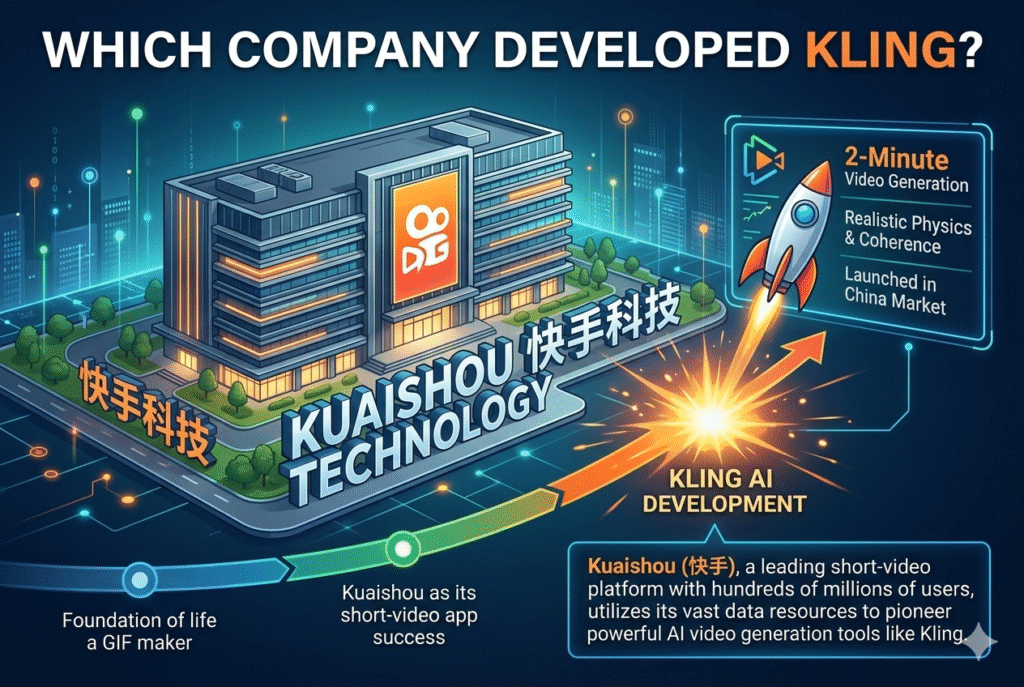
Kling AI was created by Kuaishou Technology, a major Chinese internet and technology company headquartered in Beijing, China.
Founded in 2011, Kuaishou originally started as a platform for creating and sharing short videos. Over time, it grew into one of the largest video-based social media platforms in the world.
Today, Kuaishou has hundreds of millions of daily active users, mainly through its short-video app similar to TikTok.
According to company reports, the platform has over 370 million daily active users, making it one of China’s biggest digital platforms.
With such a massive user base, Kuaishou has invested heavily in artificial intelligence, machine learning, and computer vision technologies. This investment eventually led to the development of Kling AI.
Because the technology quickly gained global attention, many users began searching online to find out “Is Kling a Chinese company?”.
The connection between Kling and Kuaishou confirms that the AI model indeed originates from China’s growing tech ecosystem.
Modern AI systems like Kling are typically developed by large technology companies with significant resources and data.
Building advanced AI models requires massive computing power, large datasets, and highly skilled researchers.
Companies like Kuaishou, Google, OpenAI, and Microsoft invest billions of dollars into AI research each year.
For example, generative AI models are trained on millions of images and videos to learn patterns, motion, and visual realism.
These models use complex neural networks to understand prompts and generate new digital content.
In Kling’s case, the technology focuses on text-to-video generation, which allows users to create realistic videos simply by describing a scene.
This is one of the reasons the question “Is Kling a Chinese company?” became popular.
People are curious about which companies and countries are leading the development of powerful AI tools.
Kuaishou has become an important player in the global AI race, especially in the field of video-based artificial intelligence.
The company has built several AI systems for video recommendation, image recognition, and digital content creation.
Kling AI is one of its most ambitious projects, designed to compete with other global AI video models.
By developing tools like Kling, Kuaishou contributes to the rapid innovation happening in the AI industry.
These technologies help creators produce content faster, enable businesses to create marketing videos easily, and open new possibilities for digital storytelling.
As Kling continues to evolve, more users will likely keep asking “Is Kling a Chinese company?” as they explore the technology and its origins.
Understanding the role of Kuaishou helps explain how Kling became one of the most talked-about AI video generators in recent years.
More Read: How Much Does 10Web Cost?
When Was Kling AI Released?
The launch of Kling AI marked an important moment in the rapid evolution of AI video generation technology.
As AI tools became more advanced in recent years, companies around the world started racing to develop systems capable of creating realistic videos from simple prompts.
In the middle of this competition, Kling AI emerged as one of the most talked-about models.
Because of its sudden popularity, many users began searching online to understand its origins and asking questions like “Is Kling a Chinese company?”.
Understanding the timeline of Kling’s development helps explain how the technology evolved and why it gained global attention so quickly.
The development of Kling AI began inside Kuaishou Technology’s AI research division, where engineers and researchers were already working on machine learning models for video processing and content recommendation.
Kuaishou had years of experience dealing with large amounts of video data because its platform hosts millions of short videos uploaded daily.
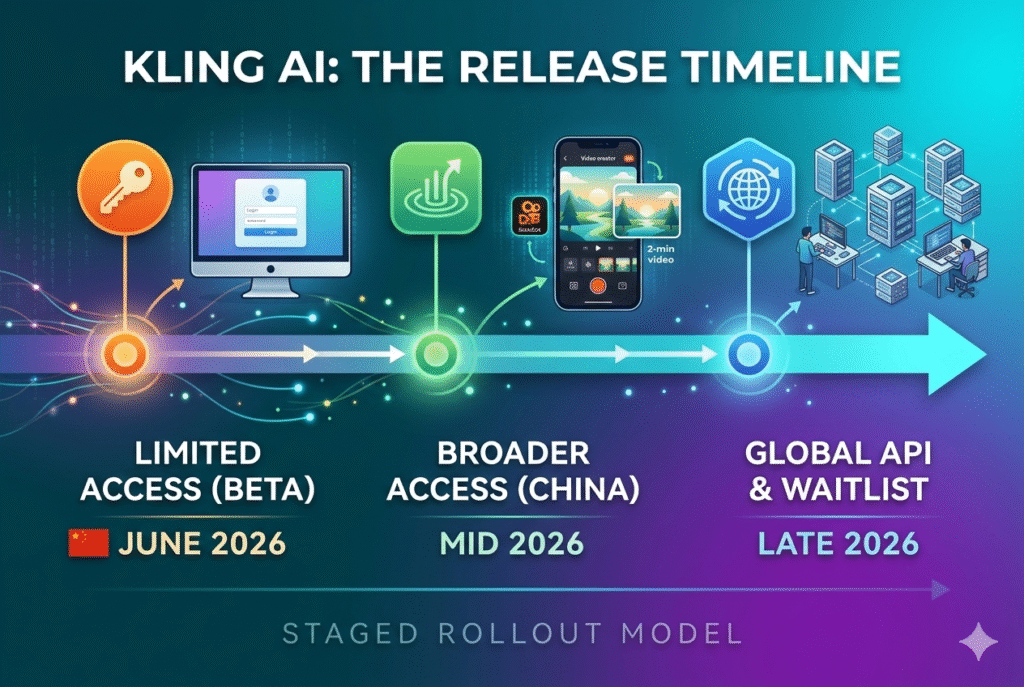
In June 2024, Kuaishou officially introduced Kling AI during a technology event in China.
The announcement showcased the model’s ability to generate high-quality videos from simple text prompts, something that previously required complex editing tools or large production teams.
One of the most impressive capabilities demonstrated during the announcement was Kling’s ability to generate 1080p videos with realistic motion and detailed scenes.
These features immediately caught the attention of developers, AI researchers, and content creators around the world.
As the technology spread across tech blogs and social media platforms, searches for “Is Kling a Chinese company?” increased rapidly because users wanted to know more about the developers behind such advanced AI technology.
After the initial announcement, Kling AI was gradually made available for testing through limited access programs and demonstrations.
Developers and creators were able to experiment with the tool and generate short AI-created videos based on written prompts or images.
Early demonstrations showed Kling producing scenes such as people walking through cities, animals moving naturally, and cinematic camera movements, which highlighted the model’s ability to simulate real-world physics and motion.
These examples helped the platform go viral in the AI community.
As more people discovered the tool, discussions about its origins continued to grow. Many users kept asking “Is Kling a Chinese company?” because the technology appeared to rival some of the most advanced AI video models developed in other parts of the world.
Since its launch, Kling has continued to receive improvements and updates as Kuaishou expands its AI research.
The company is working to refine video quality, improve motion realism, and make the system more accessible to creators globally.
This ongoing development ensures that Kling remains an important player in the rapidly evolving AI video generation industry—and keeps the question “Is Kling a Chinese company?” relevant for new users discovering the platform.
More Read: What LLM Does Replit Use?
Why Is Kling Becoming Popular?
In the fast-growing world of generative AI, new tools appear almost every month. However, only a few manage to capture global attention quickly.

Kling AI is one of those rare technologies. After its introduction in 2024, the tool spread rapidly across social media, tech communities, and content-creation platforms.
As more people discovered its capabilities, curiosity about the platform increased, leading many users to search online and ask “Is Kling a Chinese company?” to understand who developed this powerful AI model.
Several factors explain why Kling AI has become so popular, including its advanced video generation capabilities, high visual quality, and strong competition with other leading AI tools.
One of Kling’s biggest strengths is its ability to generate complex and realistic videos from simple text prompts.
Users can describe a scene in natural language, and the AI will convert it into a short video sequence.
For example, a user might type a prompt like “a drone flying over snowy mountains at sunrise,” and the AI generates a cinematic clip based on that description.
Kling can create videos up to around two minutes long in 1080p resolution, which is a significant improvement compared to many earlier AI video tools that could only generate very short clips.
This capability has impressed creators and researchers alike. Because of these powerful features, more people started asking “Is Kling a Chinese company?” to learn more about the developers behind the technology.
Another reason for Kling’s popularity is the high quality of its visual output. The AI can generate scenes with detailed lighting, natural movement, and realistic object interactions.
For instance, in demonstrations shared online, Kling was able to simulate water movement, human walking motion, and natural environmental changes with surprising realism.
This level of detail is possible because Kling uses advanced deep-learning models trained on massive video datasets.
The system analyzes patterns in motion, camera angles, and visual composition to create videos that look more cinematic than earlier AI outputs.
As these demonstrations went viral, many viewers became curious about the technology and searched “Is Kling a Chinese company?” to understand where such advanced AI development was happening.
Kling’s rise is also connected to the growing competition among AI companies developing text-to-video models.
Major tech organizations around the world are working on similar tools, including models designed to generate realistic video content automatically.
Because Kling appeared to compete with some of the most advanced AI systems, it quickly entered global conversations about the future of generative video technology.
This competition also increased public interest in the platform and sparked discussions around questions like “Is Kling a Chinese company?”.
Content creators, digital marketers, and filmmakers are especially interested in tools like Kling because they can dramatically reduce the time and cost required to produce video content. Instead of filming scenes or hiring large production teams, creators can generate visuals directly from written ideas.
For example, marketers can quickly create promotional clips for social media, while designers can visualize concepts without complex editing software.
As these practical uses continue to grow, more people are discovering the platform and asking “Is Kling a Chinese company?” while exploring the technology behind this rapidly rising AI video generator.
More Read: Can I Delete Older Luminar Neo Backups? Complete Guide for Safe Cleanup
How Kling Compares to Other AI Video Generators
As AI video technology grows rapidly, several powerful platforms are competing to dominate the market.
Along with Kling AI, tools like OpenAI Sora, Runway AI, and Pika AI have become popular among developers, creators, and marketers.
These platforms all use generative AI to turn text prompts or images into videos, but they differ in terms of features, video quality, and accessibility.
Understanding these differences also helps explain why many users search online to ask “Is Kling a Chinese company?” while exploring alternatives in the AI video space.
OpenAI’s Sora is widely known for producing some of the most photorealistic AI-generated videos available today.
The model can generate cinematic scenes with realistic lighting, textures, and physics simulations such as gravity and fluid motion.
In many comparisons, Sora is rated among the highest-quality video generators because of its strong prompt understanding and consistent visuals.
Sora can generate videos of around 20–60 seconds depending on the version, making it useful for storytelling or cinematic content.
However, access to the tool has been limited in some regions and often requires paid plans or special access.
Because of these advanced capabilities, many users comparing video AI tools often come across Kling and wonder “Is Kling a Chinese company?” when they see it mentioned alongside Sora.
Runway AI is another major player in the generative video space. Its Gen-3 and Gen-4 models are designed for creators who want greater control over video editing and motion design. One standout feature is its Motion Brush, which allows users to specify exactly which parts of a scene should move.
Runway also supports high-resolution output, including up to 4K in some cases, and includes built-in editing tools that help creators refine their videos after generation.
Compared with some other tools, Runway is particularly popular among designers, filmmakers, and marketing teams who want more creative control during production.
Pika AI focuses on speed and ease of use. The platform can generate videos much faster than many other AI tools, often producing clips in 30–90 seconds depending on the settings.
Although Pika’s video quality is generally lower than tools like Sora, it is still strong enough for social media content, quick visual experiments, and creative storytelling. Many creators prefer it because it has a simpler interface and a generous free tier.
When comparing these platforms, each tool has its own strengths. Sora is known for high realism, Runway offers advanced creative controls, and Pika focuses on speed and accessibility.
Kling AI, meanwhile, has gained attention for strong motion realism and cinematic visuals, placing it among the leading AI video generators in recent benchmarks.
Because Kling appears alongside these well-known tools in many comparisons, curiosity about its origins has grown.
That is why searches like “Is Kling a Chinese company?” continue to appear frequently among users exploring the latest AI video technologies.
Is Kling Available Worldwide?
As the popularity of AI video generators continues to grow, many users want to know whether they can actually access these tools from different parts of the world.
Since Kling AI quickly became one of the most talked-about video generation models, people frequently search “Is Kling a Chinese company?” and also ask whether the platform is available internationally.
Understanding where Kling AI can be used helps explain how widely the technology has spread.
Initially, Kling AI was mainly available in China because it was developed by the Chinese technology company Kuaishou.
Early versions required Chinese phone number verification and were mostly used by developers and creators inside the country.
However, in July 2024, Kuaishou launched a global web version of Kling AI, allowing users from many countries to register and use the platform through the official website.
Registration generally only requires an email address, and new users receive free daily credits to generate AI videos.
Because of this global release, users in regions such as:
North America
Europe
India and other parts of Asia
Southeast Asia
South America
The Middle East
can usually access the basic web interface of Kling AI and experiment with its video-generation features.
This international rollout is one reason why the question “Is Kling a Chinese company?” became widely searched around the world, as people wanted to understand the origin of the rapidly spreading technology.
Even though Kling AI has expanded globally, there are still some limitations depending on location.
The Chinese version of the platform often provides the most complete features, including mobile apps and subscription tiers specifically designed for users in mainland China.
International users may face certain restrictions such as:
Limited access to advanced features or beta tools
Slower rollout of updates compared to China
Payment options that may not be available in all countries
Temporary server limitations due to high demand
Additionally, some experimental versions of the model are still restricted to invited developers, researchers, or partner creators, especially during early testing phases.
Because of these differences in accessibility, many new users exploring the platform continue to ask “Is Kling a Chinese company?” when learning about its availability and development.
Overall, while Kling AI originated in China, its web platform is gradually becoming accessible to a global audience of creators, developers, and businesses interested in AI-generated video technology.
Is Kling Safe to Use?
Whenever a new AI platform becomes popular, users naturally begin asking questions about data privacy and security.
Since AI tools often require prompts, images, or personal accounts to function, many people want to know how their information is handled.
This is one reason the search query “Is Kling a Chinese company?” often appears alongside questions about safety and privacy.
Understanding how AI companies manage data can help users decide whether a platform like Kling AI is safe for their needs.
One of the main concerns surrounding AI platforms is how they collect and use user data.
Tools like Kling AI require users to enter prompts, upload images, or create accounts to generate videos.
In many cases, this data may be stored temporarily to improve the system’s performance or to train future AI models.
Because Kling was developed by a Chinese technology company, some users search “Is Kling a Chinese company?” to understand where the servers and data policies might be based.
Concerns about cross-border data usage and government regulations have made people more aware of the importance of checking a platform’s privacy policies before using it.
However, these concerns are not unique to Kling. Most AI platforms—whether developed in the United States, Europe, or Asia—collect some level of user data to operate effectively.
Technology companies usually implement security policies and safeguards to protect user information.
These policies often include data encryption, account authentication systems, and monitoring tools designed to prevent unauthorized access.
AI platforms also typically publish privacy policies and terms of service explaining how data is stored, used, and protected.
For example, they may clarify whether user prompts are stored for research purposes or whether uploaded files are deleted after processing.
As more users discover Kling AI, many continue to search “Is Kling a Chinese company?” not only to understand its origin but also to evaluate its security standards compared with other AI tools.
Most AI companies follow a similar approach when managing user data. Information collected from users is often used for three main purposes:
Improving AI models – Training algorithms to generate better results.
Platform functionality – Processing prompts, images, or videos to produce outputs.
Security and moderation – Detecting misuse, harmful content, or system abuse.
For example, when a user generates a video using Kling AI, the system processes the prompt through its deep-learning models to create the output.
Some of this interaction data may be analyzed to improve the accuracy and realism of future video generations.
As AI tools continue to evolve, transparency around data policies will remain important.
That is why many new users exploring the platform still ask “Is Kling a Chinese company?” while researching the technology, its developers, and how it handles user data.
More Read: What Is Content at Scale? Strategy, Benefits, and Implementation Guide
Who Can Use Kling?
AI video generation tools are no longer limited to researchers or developers.
Today, platforms like Kling AI are designed for a wide range of users who want to create visual content quickly and efficiently.
As the technology gains global attention, many people exploring the platform also ask “Is Kling a Chinese company?” while learning about its features and potential uses.
The truth is that Kling AI can be useful for many different industries, especially those that rely heavily on visual storytelling and digital media.
Content creators are among the biggest beneficiaries of AI video tools like Kling.
YouTubers, bloggers, and online educators can use the platform to generate visual scenes without expensive equipment or large production teams.
For example, a creator making a documentary-style video could type a prompt such as “a futuristic city at night with flying cars”, and the AI will generate a cinematic clip that fits the description.
This allows creators to produce high-quality visuals much faster than traditional video production methods.
Because the platform quickly gained popularity among creators, many users began researching its origins and asking “Is Kling a Chinese company?” while exploring the technology.
Digital marketers also find tools like Kling extremely valuable.
Businesses often need promotional videos for advertisements, product launches, or social media campaigns.
Traditionally, producing these videos required professional filming, editing, and graphic design.
With AI video generation, marketers can create short promotional clips in minutes.
For instance, a brand could generate a quick video showing a product in different environments or visual styles without organizing a full photoshoot.
This efficiency is one of the reasons AI video tools are becoming widely adopted by companies around the world.
Filmmakers and visual designers can use Kling AI as a creative prototyping tool.
Instead of spending weeks developing concept art or storyboards, they can generate visual scenes instantly to test ideas.
For example, a filmmaker planning a fantasy movie could generate AI scenes of landscapes, creatures, or futuristic cities to visualize the concept before actual production begins.
This can help directors communicate ideas more clearly with their teams.
As these professional uses become more common, discussions about the technology continue to grow, and questions like “Is Kling a Chinese company?” remain part of the conversation around the platform.
Social media creators are another major group adopting AI video tools.
Platforms like Instagram, TikTok, and YouTube Shorts rely heavily on short-form video content, and creators constantly need fresh visuals to keep their audiences engaged.
Kling AI allows users to quickly generate eye-catching clips that can be used in reels, short videos, or digital storytelling.
Instead of spending hours editing footage, creators can experiment with AI-generated visuals and publish content faster.
As more people in different industries start using the platform, curiosity about its background continues to grow.
That is why many new users still search “Is Kling a Chinese company?” while discovering how the technology can support their creative work.
More Read: What is Adobe Firefly and Why It Matters in 2026
Conclusion
After exploring the background, development, and features of the platform, we can clearly answer the main question: Yes, Kling is a Chinese AI model developed by the technology company Kuaishou.
The platform was introduced in 2024 as part of Kuaishou’s expansion into generative artificial intelligence and advanced video creation tools.
Since its launch, Kling has quickly gained global attention for its ability to generate realistic videos from simple text prompts and images.
Many users began searching “Is Kling a Chinese company?” because the technology appeared suddenly and demonstrated capabilities comparable to some of the most advanced AI video generators in the world.
Its realistic motion simulation, high-quality visual output, and ability to create complex scenes made it stand out in the rapidly growing AI video market.
There are several important points to remember about Kling AI and its origins.
First, Kling was developed in China by Kuaishou Technology, a major internet company headquartered in Beijing.
Kuaishou is widely known for its short-video platform, which has hundreds of millions of active users and a strong background in video-based technologies.
Second, Kling represents China’s growing investment in artificial intelligence.
Over the past decade, the country has heavily funded AI research and development, encouraging technology companies to build advanced systems.
Kling is one example of how this investment is translating into real products that compete globally.
Third, Kling is part of a new generation of AI video generation tools. Similar to platforms like OpenAI’s Sora, Runway AI, and Pika AI, Kling allows users to create videos using text prompts or images.
However, its strong motion realism and cinematic visuals have made it particularly impressive to many users and creators.
Finally, the platform is gradually becoming accessible to users worldwide. As more creators, marketers, and designers experiment with the tool, curiosity about its origins continues to grow.
This is why the search query “Is Kling a Chinese company?” remains common among people discovering the technology for the first time.
In summary, Kling AI is indeed a Chinese-developed technology created by Kuaishou. Its rapid rise highlights how quickly the field of AI-generated video is evolving and how companies from different parts of the world are competing to shape the future of digital content creation.