

Artificial intelligence is transforming how organizations handle information, and document processing is one area seeing rapid change.
Many people now ask, What does Doc AI do? In simple terms, Doc AI refers to artificial intelligence tools that can read, understand, and organize documents automatically.
These tools use technologies such as machine learning, natural language processing, and optical character recognition (OCR) to analyze files like PDFs, invoices, contracts, and forms.
Instead of manually reviewing every document, businesses can rely on AI systems to extract important information, categorize files, and make them easier to search and manage.
Understanding What does Doc AI do? also means looking at how it improves efficiency. According to industry research, employees spend nearly 20–30% of their work time searching for or managing documents.
Document AI tools help reduce this time by automatically identifying key details such as names, dates, totals, or account numbers.
For example, in finance departments, Doc AI can scan hundreds of invoices and instantly extract payment information, reducing manual data entry and minimizing human errors.
Another reason organizations are exploring What does Doc AI do? is the growing need for automation.
Businesses generate massive amounts of data every day, from contracts and receipts to reports and applications.
Manually processing these documents can be slow and expensive. AI-powered document tools streamline these tasks by automatically organizing files and routing them to the right departments.
In healthcare, for instance, Doc AI can quickly analyze patient records and extract relevant information for doctors or administrators.
The importance of automation in document management is becoming increasingly clear as companies move toward digital operations.
Studies suggest that automated document processing can reduce processing time by up to 80% in some workflows. This not only saves time but also allows employees to focus on more strategic tasks instead of repetitive paperwork.
By understanding What does Doc AI do?, businesses can see how these intelligent tools are helping modern organizations manage documents faster, more accurately, and more efficiently.
More Read: What Is Git Law?
What Does Doc AI Do? Understanding the Core Features
Artificial intelligence is transforming the way organizations handle large volumes of documents.
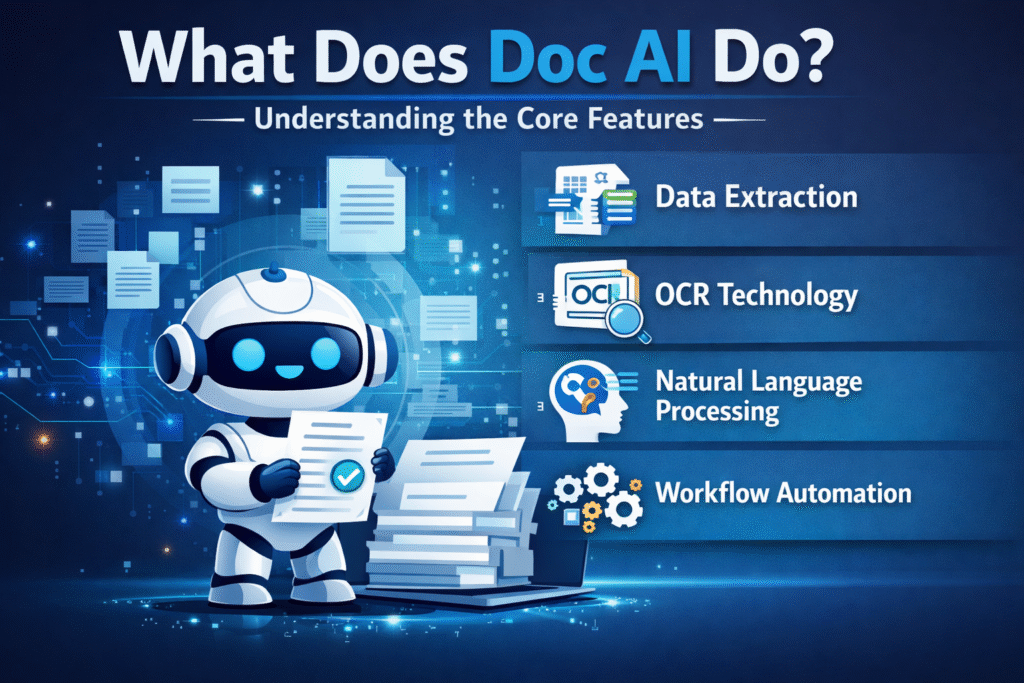
Many businesses exploring automation often ask, What does Doc AI do? In simple terms, Doc AI uses advanced technologies such as machine learning, natural language processing (NLP), and optical character recognition (OCR) to analyze, process, and manage documents automatically.
Instead of employees manually reviewing files, AI-powered tools can read and understand documents within seconds.
One of the most important capabilities of Doc AI is AI document analysis. This feature allows the system to scan documents such as contracts, invoices, reports, and forms to understand their content.
For example, an AI system can identify key information like company names, payment details, dates, and signatures.
Large organizations that process thousands of documents daily use this technology to improve accuracy and save time.
Another major function that explains What does Doc AI do? is automated data extraction. Businesses often deal with documents that contain important structured and unstructured data.
Doc AI tools can automatically extract key details from invoices, receipts, bank statements, and other documents.
For instance, in finance departments, AI can quickly capture invoice numbers, tax amounts, and vendor details, reducing manual data entry and minimizing errors.
According to industry reports, automated document processing can reduce data entry time by up to 70–80%.
Doc AI also supports document classification and organization. When companies receive hundreds or even thousands of documents daily, sorting them manually becomes difficult.
AI systems can automatically categorize documents into types such as contracts, forms, invoices, or reports.
This helps businesses organize files efficiently and ensures that documents are routed to the correct teams or departments.
Finally, another important aspect when discussing What does Doc AI do? is smart search and content recognition.
AI-powered systems can understand the meaning of words and phrases within documents, allowing users to quickly search for specific information.
For example, instead of scrolling through hundreds of pages, an employee can simply search for a keyword and instantly find the relevant document or data.
Overall, Doc AI makes document management faster, more accurate, and more efficient for modern organizations.
More Read: What Does DealMachine Do?
What Does Doc AI Do? Key Benefits for Businesses
In today’s digital workplace, organizations handle thousands of documents every day, including invoices, contracts, reports, and application forms.
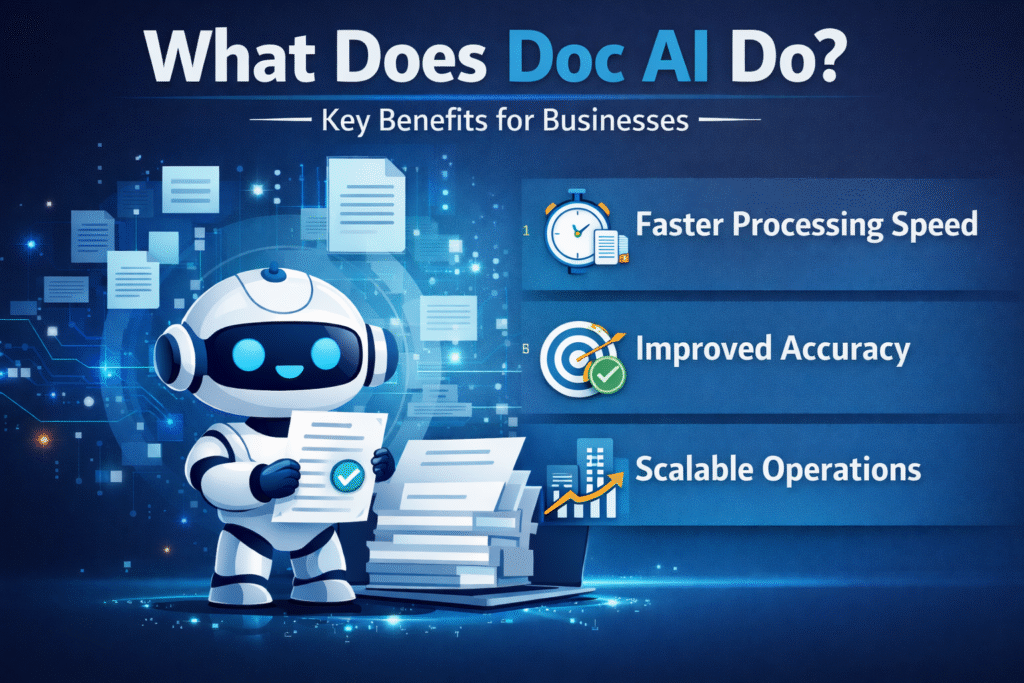
Because of this growing volume of data, many businesses are exploring automation and often ask, What does Doc AI do? Doc AI refers to artificial intelligence tools designed to process, analyze, and manage documents automatically.
These systems help companies reduce manual work and streamline document-related tasks.
One of the biggest advantages of Doc AI is that it saves time on manual document processing.
Traditionally, employees had to review documents line by line and manually enter important details into databases or spreadsheets.
This process could take hours or even days. AI-powered document tools can scan and analyze documents in seconds, extracting key information automatically.
According to industry reports, automated document processing can reduce document handling time by up to 60–80%, making operations much faster.
Another important benefit when understanding What does Doc AI do? is its ability to reduce human errors. Manual data entry often leads to mistakes such as incorrect numbers, missing information, or duplicated records.
AI systems are designed to identify patterns and extract data with high accuracy. For example, in finance departments, Doc AI can accurately capture invoice totals, dates, and vendor details, ensuring that financial records remain consistent and reliable.
Doc AI also helps improve productivity and workflow efficiency. By automating repetitive document tasks, employees can focus on more valuable activities such as analysis, decision-making, or customer service.
For example, legal teams can use AI tools to review contracts quickly, while HR departments can process job applications and employee documents more efficiently.
Finally, companies that manage large amounts of data often wonder What does Doc AI do? when dealing with document overload.
AI systems help manage large volumes of documents by automatically organizing, categorizing, and storing files. This makes it easier for teams to locate important information whenever they need it.
Overall, Doc AI helps businesses work smarter by saving time, improving accuracy, and handling documents more efficiently.
More Read: What is bind AI? A Clear and Simple Explanation
What Does Doc AI Do? Common Use Cases in Different Industries
Artificial intelligence is transforming document management across many industries. When people ask, What does Doc AI do?, the answer often becomes clearer by looking at how different sectors use it in real-world situations.
Doc AI helps organizations process documents faster, extract important information, and reduce manual work across multiple workflows.
In the finance industry, Doc AI is widely used for invoice and receipt processing. Finance teams handle thousands of financial documents every month, including purchase invoices, payment receipts, and expense reports.
Instead of manually entering this information into accounting systems, Doc AI can automatically scan invoices, extract details like vendor names, dates, tax amounts, and totals, and upload them into databases.
Studies suggest that automated invoice processing can reduce processing costs by 50–70%, making it a valuable tool for financial departments.
Another common example when discussing What does Doc AI do? can be seen in healthcare. Hospitals and clinics generate massive volumes of patient records, lab reports, prescriptions, and insurance documents.
Doc AI helps by organizing and extracting important information from these records, making it easier for healthcare professionals to access patient data quickly.
For instance, AI systems can identify patient details, medical history, and treatment information within seconds, helping doctors focus more on patient care rather than paperwork.
The legal industry also benefits significantly from document AI.
Law firms often deal with complex contracts and lengthy legal documents. Doc AI can assist with contract analysis and document review by identifying important clauses, key dates, and obligations within agreements.
This technology helps lawyers review documents much faster and reduces the risk of missing important information.
In education and research, Doc AI helps manage large collections of academic papers, research reports, and institutional documents.
Universities and research organizations use AI tools to organize documents, extract key insights, and make research materials easier to search and access.
This allows students, researchers, and faculty members to find relevant information quickly.
Overall, understanding What does Doc AI do? shows how this technology is helping industries manage documents more efficiently, saving time while improving accuracy and accessibility.
More Read: What is a nano editor?
What Does Doc AI Do? How the Technology Works
Modern businesses are increasingly turning to artificial intelligence to manage their growing document workloads.
Many organizations ask, What does Doc AI do? In simple terms, Doc AI uses advanced technologies to read, understand, and process documents automatically.
By combining multiple AI techniques, these systems can analyze both structured and unstructured documents with impressive speed and accuracy.
One of the core technologies behind Doc AI is machine learning and natural language processing (NLP).
Machine learning enables the system to learn patterns from large datasets and improve its performance over time.
NLP allows the AI to understand human language within documents such as contracts, emails, and reports.
For example, an NLP-powered system can identify important information like company names, dates, and key terms in a contract.
When organizations explore What does Doc AI do?, they often discover that these technologies help computers interpret documents almost like humans do.
Another key component of document AI is Optical Character Recognition (OCR). OCR technology allows the system to convert scanned documents, printed text, or images into machine-readable text.
This is particularly useful for processing invoices, receipts, handwritten forms, or old paper records that have been digitized.
According to industry studies, OCR combined with AI can achieve over 90% accuracy in extracting text from clear digital documents, making it a reliable tool for businesses that handle large volumes of paperwork.
In addition to understanding text, Doc AI focuses heavily on data extraction and automation.
Once the document is analyzed, the system can automatically extract key information such as invoice numbers, payment amounts, addresses, or product details.
This data can then be transferred directly into databases, accounting software, or business management systems. By automating these tasks, companies reduce manual work and speed up document processing.
Overall, when businesses ask What does Doc AI do?, the answer lies in its ability to combine machine learning, OCR, and automation to transform traditional document management into a faster and more intelligent process.
More Read: What is a Nano Editor?
What Does Doc AI Do? Advantages Compared to Traditional Document Processing
As businesses continue to digitize their operations, many organizations are exploring intelligent tools to handle large volumes of paperwork.
A common question that arises is, What does Doc AI do? In simple terms, Doc AI uses artificial intelligence to process, analyze, and organize documents automatically.
Compared to traditional document management methods, AI-powered systems offer several major advantages, including faster processing, improved accuracy, and better scalability for large organizations.
One of the biggest benefits of document AI is faster processing speed. Traditional document processing often requires employees to manually read, review, and enter data from files such as invoices, forms, or contracts.
This can take hours or even days when dealing with large volumes of paperwork. Doc AI systems, however, can scan and analyze documents within seconds.
For example, an AI system can process hundreds of invoices in the time it would take a human to process only a few.
Studies show that automated document processing can reduce document handling time by up to 70–80%, helping businesses operate more efficiently.
Another key advantage when understanding What does Doc AI do? is better accuracy.
Manual data entry often leads to mistakes such as incorrect numbers, missing details, or duplicate records.
AI-powered systems use advanced algorithms to extract and verify information, reducing the chances of human error.
For instance, in finance or accounting departments, Doc AI can accurately capture payment amounts, tax values, and transaction dates from invoices or receipts.
Doc AI also provides scalability for large organizations. As businesses grow, the number of documents they handle increases significantly. Traditional systems may struggle to manage this workload efficiently.
AI-based document processing can easily scale to handle thousands or even millions of documents without slowing down operations.
Overall, when companies ask What does Doc AI do?, they often discover that it helps them process documents faster, maintain higher accuracy, and manage growing workloads more effectively.
More Read: How to Up My Unearther Level Fast: Smart Strategies for Quick Progress
What Does Doc AI Do? Limitations and Challenges
While AI-powered document tools offer many advantages, it is also important to understand their limitations.
Many organizations exploring this technology often ask, What does Doc AI do? While Doc AI can automate document processing, extract data, and organize information efficiently, there are still several challenges businesses must consider before fully implementing these systems.
One major concern is data privacy and security. Businesses often process sensitive information such as financial records, personal data, legal documents, and medical reports.
When using AI-based document systems, organizations must ensure that this data is stored and processed securely.
Companies need strong security measures, including encryption and access control, to prevent data breaches.
According to cybersecurity reports, data protection has become a top priority for organizations adopting AI technologies.
Another challenge when understanding What does Doc AI do? is that its accuracy can depend on document quality.
AI systems perform best when documents are clear, well-structured, and easy to read. However, if documents are blurry, poorly scanned, handwritten, or damaged, the system may struggle to extract information correctly.
For example, an invoice with unclear text or unusual formatting might lead to incorrect data extraction, requiring manual review.
Organizations also need to consider the need for proper training and integration. Doc AI systems must often be trained using large datasets so they can accurately recognize document patterns and information.
In addition, businesses must integrate these tools with their existing systems, such as accounting software, document management platforms, or enterprise resource planning (ERP) systems.
Without proper setup and training, the AI may not perform at its full potential.
Overall, while companies continue to explore What does Doc AI do?, they must also address challenges related to data privacy, document quality, and system integration to ensure successful implementation.
What Does Doc AI Do? Popular Tools and Platforms
As organizations continue adopting automation, many businesses are exploring intelligent tools to manage documents more efficiently.
This often leads to the question, What does Doc AI do? In general, Doc AI solutions use artificial intelligence to read, analyze, and process documents automatically.
These systems help businesses extract important information, classify files, and streamline document-heavy workflows.
Today, several companies provide document AI solutions designed to automate document management tasks.
Popular platforms include tools developed by major technology companies as well as specialized document automation providers.
These solutions typically combine technologies such as machine learning, natural language processing (NLP), and optical character recognition (OCR) to understand document content.
For example, many AI document tools can process invoices, contracts, forms, and reports, extracting key details like names, dates, totals, and addresses within seconds.
According to industry estimates, businesses can reduce manual document processing time by up to 70% by adopting AI-powered document tools.
When exploring What does Doc AI do?, it is also important to compare the features and capabilities offered by different solutions.
Most document AI platforms provide core features such as automated data extraction, document classification, and smart search capabilities.
Some advanced solutions also include features like contract analysis, workflow automation, and integration with business software such as accounting systems or customer relationship management (CRM) platforms.
Another difference between document AI tools is their ability to handle structured and unstructured data.
Some solutions are designed specifically for structured documents like invoices and forms, while others can analyze complex documents such as legal contracts or research reports.
Businesses often choose a solution based on their document type, industry requirements, and workflow needs.
Overall, understanding What does Doc AI do? helps organizations identify the right tools for automating document processing.
By comparing features such as data extraction accuracy, automation capabilities, and system integrations, companies can select a solution that best supports their operational goals.
What Does Doc AI Do? Future of AI in Document Automation
Artificial intelligence is rapidly transforming how businesses operate, especially when it comes to managing and analyzing information.
As organizations handle growing volumes of digital documents, many professionals are asking, What does Doc AI do? In simple terms, Doc AI helps companies automate document processing, extract valuable data, and improve decision-making through intelligent analysis.
As AI technology continues to evolve, its role in business operations is becoming more significant.
One of the most noticeable trends is the increasing role of AI in business operations.
Companies across industries such as finance, healthcare, and logistics are adopting AI tools to automate repetitive tasks.
Document AI systems can process invoices, contracts, forms, and reports much faster than manual methods.
For example, many financial institutions now use AI to automatically verify documents during loan applications or customer onboarding.
According to industry research, businesses that adopt AI-driven automation can improve operational efficiency by up to 40%, highlighting the growing importance of technologies like Doc AI.
Another important development when considering What does Doc AI do? is the rise of document intelligence.
Modern AI systems are no longer limited to basic data extraction. Instead, they can understand context, identify relationships within text, and generate insights from documents.
This means businesses can not only organize documents but also analyze them for patterns and trends.
For instance, legal firms can use document intelligence tools to review contracts and detect important clauses automatically.
Emerging trends also include better integration with cloud platforms, improved accuracy in handwriting recognition, and smarter AI models capable of learning from new data.
These innovations are making document AI systems more powerful and accessible to businesses of all sizes.
Overall, understanding What does Doc AI do? highlights how artificial intelligence is shaping the future of document management and helping organizations operate more efficiently in a data-driven world.
Conclusion: What Does Doc AI Do and Why It Matters
As organizations continue to manage growing volumes of digital information, many professionals are exploring intelligent solutions to improve efficiency.
A common question that arises is, What does Doc AI do? In simple terms, Doc AI uses artificial intelligence to automatically read, analyze, and process documents such as invoices, contracts, forms, and reports.
By combining technologies like machine learning, natural language processing (NLP), and optical character recognition (OCR), Doc AI can extract key data, classify documents, and organize information quickly and accurately.
One of the main benefits of Doc AI is its ability to automate document processing. Instead of manually reviewing files and entering data into systems, businesses can rely on AI tools to handle these tasks automatically.
This significantly reduces processing time and improves efficiency. Research shows that automated document processing can cut manual work by up to 70–80%, allowing employees to focus on more strategic tasks.
Understanding What does Doc AI do? also highlights its impact on accuracy and productivity. AI-powered systems minimize human errors that often occur during manual data entry.
For example, Doc AI can accurately extract invoice totals, contract details, and customer information, ensuring that records remain consistent and reliable.
In addition, these systems can process thousands of documents quickly, making them highly scalable for large organizations.
Another reason businesses are increasingly adopting Doc AI tools is their ability to manage large volumes of data efficiently.
As companies grow, the number of documents they generate also increases.
AI-powered document solutions help organize, categorize, and store these files, making it easier to retrieve important information whenever needed.
Overall, when businesses understand What does Doc AI do?, they realize that these tools provide faster processing, improved accuracy, and better document management.
By adopting Doc AI solutions, organizations can streamline operations, reduce operational costs, and improve overall productivity in a data-driven business environment.