

AI Data Centers Revive Obsolete Peaker Power Plants as artificial intelligence reshapes not just software and innovation—but the global energy system itself.
Over the past few years, AI adoption has exploded across industries, from generative AI tools to real-time analytics, autonomous systems, and large-scale machine learning models.
Behind every AI breakthrough sits a massive data center consuming extraordinary amounts of electricity, often operating 24/7 without interruption.
AI Data Center Revive Obsolete Peaker Power Plants: Powerful Energy Shifts
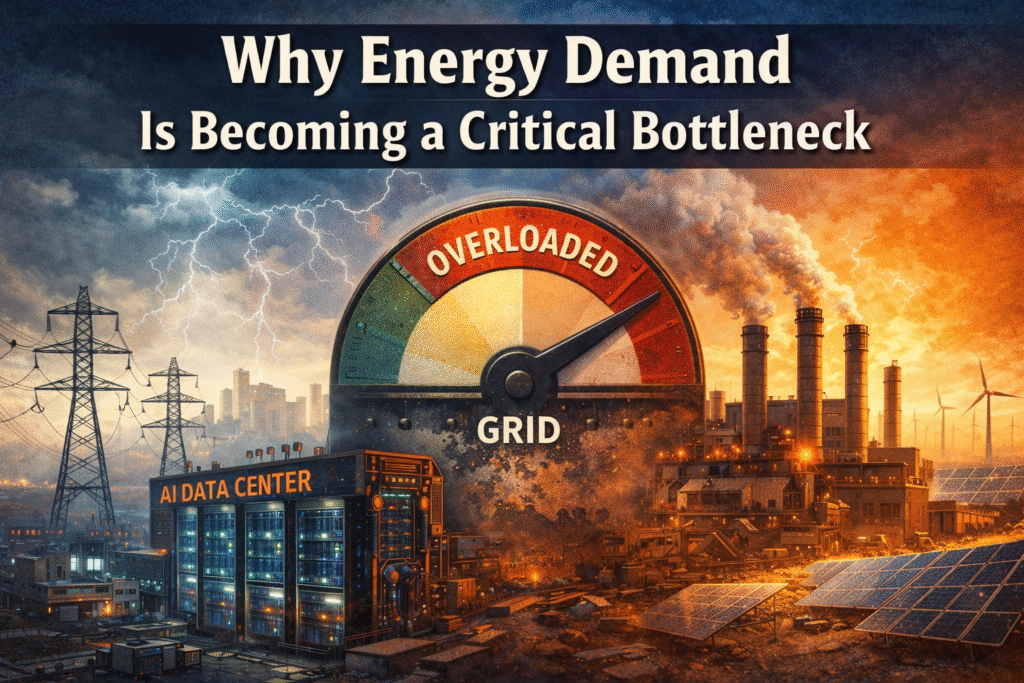
According to the International Energy Agency (IEA), global data center electricity consumption could double by 2030, driven largely by AI workloads. A single large AI data center can consume as much power as a mid-sized city.
Unlike traditional cloud services, AI training and inference require dense GPU clusters that draw constant, high-intensity power, placing unprecedented strain on aging electrical grids.
In regions like the U.S., Ireland, and parts of Asia, utilities are struggling to meet sudden spikes in demand. Renewable energy sources, while growing rapidly, often lack the consistency needed for always-on AI operations.
This mismatch between demand and supply has created a bottleneck—one that utilities must solve quickly to avoid blackouts and grid instability.
Also Read :- How AI Is Accelerating the Global E-Waste Crisis
What Are Peaker Power Plants—and Why They Were Considered Obsolete
Peaker power plants are typically gas- or oil-fired facilities designed to operate only during periods of peak electricity demand.
Over the last decade, many were retired due to high emissions, poor efficiency, and rising climate regulations. Cleaner energy alternatives and battery storage were expected to replace them entirely.
AI’s Rapid Expansion Is Reviving Aging Power Infrastructure
Now, AI Data Centers Revive Obsolete Peaker Power Plants because they offer one critical advantage: speed. Utilities can restart peaker plants far faster than building new power stations or upgrading transmission infrastructure.
In states like California and Virginia, previously mothballed plants are being brought back online to stabilize grids supporting AI hubs.
This unexpected revival highlights a growing tension between AI innovation and sustainability—one that policymakers, tech companies, and energy providers can no longer ignore.
For deeper insight, see analysis from the IEA and U.S. Energy Information Administration (EIA) on data center energy trends.
Understanding Peaker Power Plants
AI Data Centers Revive Obsolete Peaker Power Plants AI Data Centers Revive Obsolete Peaker Power Plants by pushing electricity grids to their limits, forcing utilities to rely again on energy sources once considered outdated.
To understand why this is happening, it’s essential to first look at what peaker power plants are, how they function, and why many were phased out in the first place.
What Peaker Power Plants Are and How They Work
Peaker power plants are electricity-generating facilities designed to operate only during periods of peak demand—such as hot summer afternoons or unexpected surges in usage. Unlike baseload plants that run continuously, peaker plants can start up quickly.
often within minutes, making them ideal for emergency or short-term supply gaps. Most peaker plants run on natural gas or oil and are intentionally kept on standby until the grid needs an immediate boost.
The Historical Role of Peaker Plants in Electricity Grids
For decades, peaker plants played a critical role in stabilizing electricity grids. Before large-scale renewable energy and battery storage existed.
utilities relied on peaker plants to prevent blackouts during high-demand periods. In the early 2000s, peaker plants were common in fast-growing urban areas where electricity demand fluctuated sharply throughout the day.
Why Many Peaker Plants Were Retired or Reduced in Use
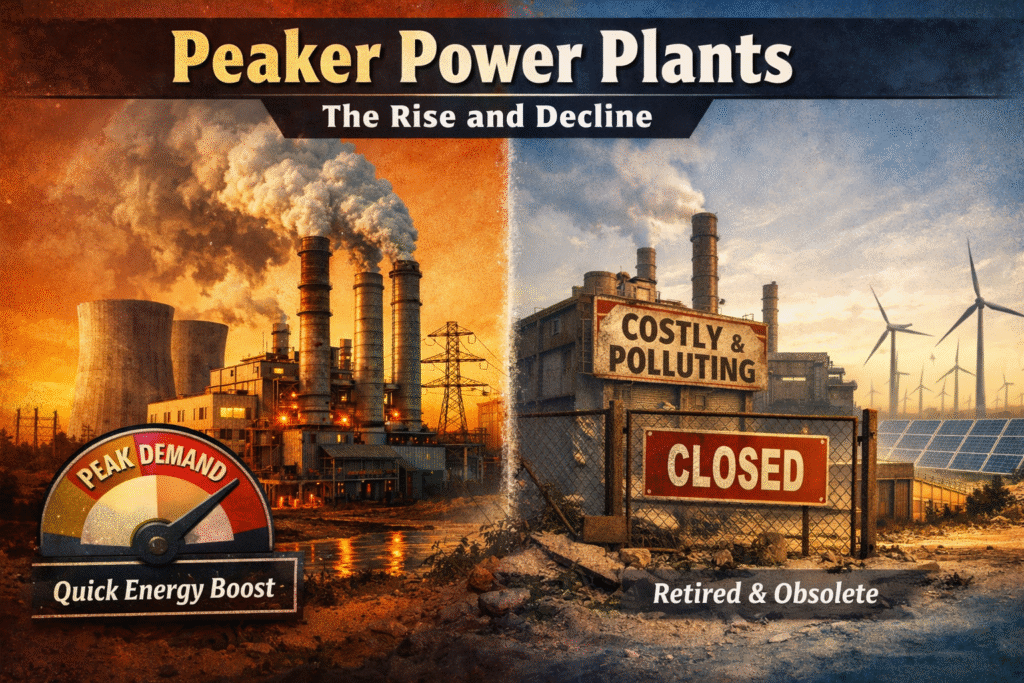
Over time, advancements in renewable energy, grid efficiency, and energy storage reduced the need for peaker plants. Solar and wind power, combined with improved demand forecasting, allowed utilities to manage peaks more effectively.
Additionally, stricter environmental regulations and rising fuel costs made peaker plants less attractive to operate. As a result, many facilities were retired, mothballed, or used far less frequently by the late 2010s.
Environmental and Cost Concerns Associated With Peaker Plants
Peaker plants are among the least efficient power sources on the grid. According to the U.S. Energy Information Administration, they can emit significantly more carbon dioxide per unit of electricity than modern combined-cycle plants. They also contribute to local air pollution, disproportionately affecting nearby communities.
From a cost perspective, peaker plants are expensive to run due to fuel prices and low utilization rates, which is why utilities historically avoided them whenever possible.
Yet today, as AI Data Centers Revive Obsolete Peaker Power Plants, these once-retired assets are being reconsidered as a fast—but controversial—solution to the growing energy demands of artificial intelligence.
The Energy Appetite of AI Data Centers
AI Data Centers Revive Obsolete Peaker Power Plants largely because AI workloads place fundamentally different demands on electricity grids compared to traditional cloud computing.
While cloud platforms were originally built to handle email, storage, streaming, and enterprise applications with flexible load patterns, AI systems operate at a completely different scale and intensity.
How AI Workloads Differ From Traditional Cloud Computing
Traditional cloud computing workloads are often intermittent and elastic. Tasks like file storage, web hosting, or SaaS applications can scale up or down without major disruption.
AI workloads, however, involve training massive models and running real-time inference that require sustained, high-performance computing.
Training a large language model can take weeks of nonstop processing, drawing enormous and continuous amounts of power that grids were never designed to support at scale.
GPUs, High-Density Servers, and Continuous Power Demand
At the core of AI data centers are GPUs and specialized accelerators packed densely into server racks. A single AI-focused rack can consume 5–10 times more electricity than a conventional cloud rack.
According to industry estimates, some AI data centers already exceed 100 megawatts in power demand—enough to power tens of thousands of homes. This constant, high-density energy draw leaves little room for fluctuation, making outages or power dips extremely costly.
Why AI Data Centers Require Ultra-Reliable, On-Demand Electricity
AI systems are highly sensitive to power interruptions. Even brief outages can corrupt training runs, damage hardware, or cause service failures for AI-driven products. As a result, AI data centers demand ultra-reliable, always-on electricity with instant backup.
Renewable energy alone, while cleaner, often cannot guarantee uninterrupted supply due to variability in wind and solar output. This reliability gap is a key reason AI Data Centers Revive Obsolete Peaker Power Plants, which can be activated quickly to stabilize the grid during demand spikes.
Geographic Clustering of AI Facilities and Grid Stress
Another major challenge is geographic concentration. AI data centers tend to cluster near major network hubs, tech talent pools, and favorable tax regions—such as Northern Virginia, Texas, and parts of Western Europe.
This clustering places intense localized pressure on regional grids. In some areas, utilities have warned that new AI facilities could overwhelm existing infrastructure unless emergency generation sources are brought back online.
As AI adoption accelerates globally, AI Data Centers Revive Obsolete Peaker Power Plants not by choice, but by necessity—highlighting how digital innovation is increasingly reshaping physical energy systems in unexpected ways.
Why Obsolete Peaker Plants Are Coming Back
AI Data Centers Revive Obsolete Peaker Power Plants as electricity grids struggle to keep pace with sudden, massive surges in demand driven by artificial intelligence. Unlike gradual increases in household or commercial power use, AI-related demand can spike abruptly—creating instability that utilities must address immediately.
Grid Instability Caused by Sudden AI Energy Spikes
AI workloads do not ramp up slowly. When large-scale model training begins or inference demand surges, energy consumption can jump within minutes. These sharp spikes disrupt grid balance, increasing the risk of voltage drops and localized outages.
In regions with heavy AI data center concentration, grid operators have reported unprecedented load volatility, forcing emergency interventions to maintain reliability.
Renewable Energy Limitations for 24/7 AI Operations
Renewable energy sources play a crucial role in decarbonizing electricity, but they face limitations when supporting nonstop AI operations. Solar power drops at night, and wind output can fluctuate unpredictably.
While battery storage helps smooth short-term gaps, it is often insufficient for extended periods of high AI demand. This reliability challenge has made it difficult for renewables alone to support always-on AI data centers, contributing to why AI Data Centers Revive Obsolete Peaker Power Plants as a backup solution.
Speed Advantage: Peaker Plants vs Building New Infrastructure
One of the strongest advantages of peaker power plants is speed. Restarting an existing peaker plant can take weeks or months, whereas building new power stations, transmission lines, or large-scale storage facilities can take years.
For utilities facing immediate grid stress, peaker plants offer a fast, familiar option to bridge the supply gap without long approval processes or construction delays.
Utility Companies’ Short-Term Solutions to Avoid Outages
To prevent blackouts, utility companies are adopting short-term measures such as reactivating retired peaker plants, extending the life of aging facilities, and entering temporary power purchase agreements.
Some utilities are also deploying mobile gas turbines near AI hubs to provide rapid-response power. While these measures are not ideal from a sustainability standpoint, they help maintain grid stability as long-term infrastructure upgrades are planned.
Together, these pressures explain why AI Data Centers Revive Obsolete Peaker Power Plants—not as a permanent solution, but as an urgent response to the growing mismatch between AI-driven energy demand and existing grid capacity.
Environmental and Economic Consequences
AI Data Centers Revive Obsolete Peaker Power Plants, and while this helps stabilize electricity grids in the short term, it also introduces serious environmental and economic consequences that are becoming harder to ignore.
Increased Carbon Emissions and Air Pollution
Peaker power plants are among the most carbon-intensive sources of electricity on the grid. Because they are designed for quick starts rather than efficiency, they burn more fuel per unit of energy produced.
When AI-driven demand forces these plants back into service, overall carbon emissions rise sharply. According to energy analysts, peaker plants can emit several times more CO₂ than modern combined-cycle natural gas plants, along with higher levels of nitrogen oxides and particulate matter that degrade air quality.
Impact on Local Communities Near Peaker Plants
The environmental burden of peaker plants is not distributed evenly. Many of these facilities are located near densely populated or historically marginalized communities.
Increased operation means more exposure to air pollution, which has been linked to higher rates of asthma, cardiovascular disease, and other health issues. As AI data centers expand, nearby residents often bear the hidden health costs of keeping digital infrastructure running.
Rising Electricity Costs for Consumers
Operating peaker plants is expensive. Fuel costs, maintenance, and inefficiency make them one of the costliest ways to generate electricity. When utilities rely on peaker plants to meet AI-related demand, those costs are frequently passed on to consumers through higher electricity bills.
Even households and small businesses that do not directly benefit from AI services may end up paying more as utilities recover the expense of emergency power generation.
Conflict Between AI Growth and Climate Goals
Perhaps the biggest concern is the growing conflict between rapid AI expansion and global climate commitments. Governments and corporations have pledged to cut emissions and transition to clean energy.
yet the revival of peaker plants moves grids in the opposite direction. This tension raises difficult questions about whether AI innovation is advancing faster than the infrastructure needed to support it sustainably.
As AI Data Centers Revive Obsolete Peaker Power Plants, the challenge is no longer just about keeping the lights on—it’s about balancing technological progress with environmental responsibility, public health, and long-term climate goals.
Regulatory and Policy Challenges
As AI Data Centers Revive Obsolete Peaker Power Plants, regulatory systems are struggling to keep pace with the speed and scale of AI-driven energy demand.
Many of today’s electricity policies were designed for predictable industrial growth—not for data centers that can add city-level power loads almost overnight.
Lack of Updated Grid Regulations for AI-Driven Demand
Most grid regulations were written before large-scale AI workloads existed. Utilities are often required to plan years in advance for demand growth, but AI data centers can trigger sudden load increases that fall outside traditional forecasting models.
This regulatory gap leaves grid operators with limited tools to manage AI-related spikes, pushing them toward quick fixes like reactivating peaker plants rather than pursuing long-term infrastructure upgrades.
Permitting Issues and Emergency Power Authorizations
Building new power plants, transmission lines, or large battery systems requires lengthy permitting processes that can take five to ten years. In contrast, restarting an existing peaker plant often requires fewer approvals—especially under emergency power authorizations.
As AI Data Centers Revive Obsolete Peaker Power Plants, regulators are increasingly granting temporary exemptions or emergency permits to avoid blackouts, even when those decisions conflict with environmental objectives.
Pressure on Governments to Balance Innovation and Sustainability
Governments face growing pressure from both sides. On one hand, AI is viewed as a strategic economic priority, driving productivity, competitiveness, and national security. On the other, climate commitments demand reductions in fossil fuel use and emissions.
Supporting AI growth without upgrading clean energy infrastructure forces policymakers into difficult trade-offs, where short-term economic gains risk long-term environmental setbacks.
Transparency Concerns Around AI Energy Consumption
Another major challenge is transparency. Many AI companies do not publicly disclose detailed energy usage data for their data centers, making it harder for regulators and communities to assess the true impact on local grids.
Without clear reporting standards, it becomes difficult to plan sustainable solutions or hold stakeholders accountable.Ultimately, as AI Data Centers Revive Obsolete Peaker Power Plants, regulatory reform and transparency will be critical.
Without updated policies that reflect AI’s unique energy footprint, governments may find themselves repeatedly relying on outdated power sources to support next-generation technology.
Industry Responses and Alternatives
As AI Data Centers Revive Obsolete Peaker Power Plants, technology companies and energy providers are also racing to develop cleaner, long-term alternatives that can support AI growth without locking grids into high-emission solutions. These responses reveal a widening gap between ambition and reality.
Investments in Clean Energy–Powered Data Centers
Major AI and cloud companies are investing billions of dollars in renewable-powered data centers. Long-term power purchase agreements (PPAs) for wind and solar have become common, with hyperscalers claiming they will operate on 100% clean energy.
New data centers are increasingly designed with on-site solar, advanced cooling systems, and energy-efficient hardware. However, while these investments reduce annual carbon footprints, they often fail to address the real-time reliability needs of AI workloads.
Battery Storage and Grid-Scale Energy Solutions
Battery storage is widely seen as a key solution for smoothing AI-related energy spikes. Grid-scale lithium-ion batteries can store excess renewable energy and release it during peak demand. In theory, this reduces reliance on peaker plants.
In practice, battery capacity is still limited and expensive. Most current storage systems can only supply power for a few hours, which is insufficient for prolonged AI training cycles or multi-day demand surges.
Nuclear, Geothermal, and Advanced Renewable Options
To overcome intermittency issues, some AI companies are exploring alternative clean energy sources. Small modular nuclear reactors (SMRs) offer consistent, carbon-free baseload power and are attracting growing interest from data center operators.
Geothermal energy, especially enhanced geothermal systems, provides reliable 24/7 electricity in certain regions. Advanced renewables like next-generation wind and long-duration storage technologies also show promise—but most remain years away from large-scale deployment.
AI Companies’ Sustainability Pledges vs Real-World Outcomes
Despite strong public sustainability pledges, real-world outcomes often fall short. Many AI firms offset emissions on paper while still relying on fossil-fuel-heavy grids in practice.
When reliability is at risk, utilities turn to peaker plants—regardless of corporate climate goals. This disconnect explains why AI Data Centers Revive Obsolete Peaker Power Plants even as sustainability commitments grow louder.
The path forward will depend on whether clean energy solutions can scale as fast as AI itself. Without rapid investment and policy alignment, short-term fixes may continue to undermine long-term climate ambitions.