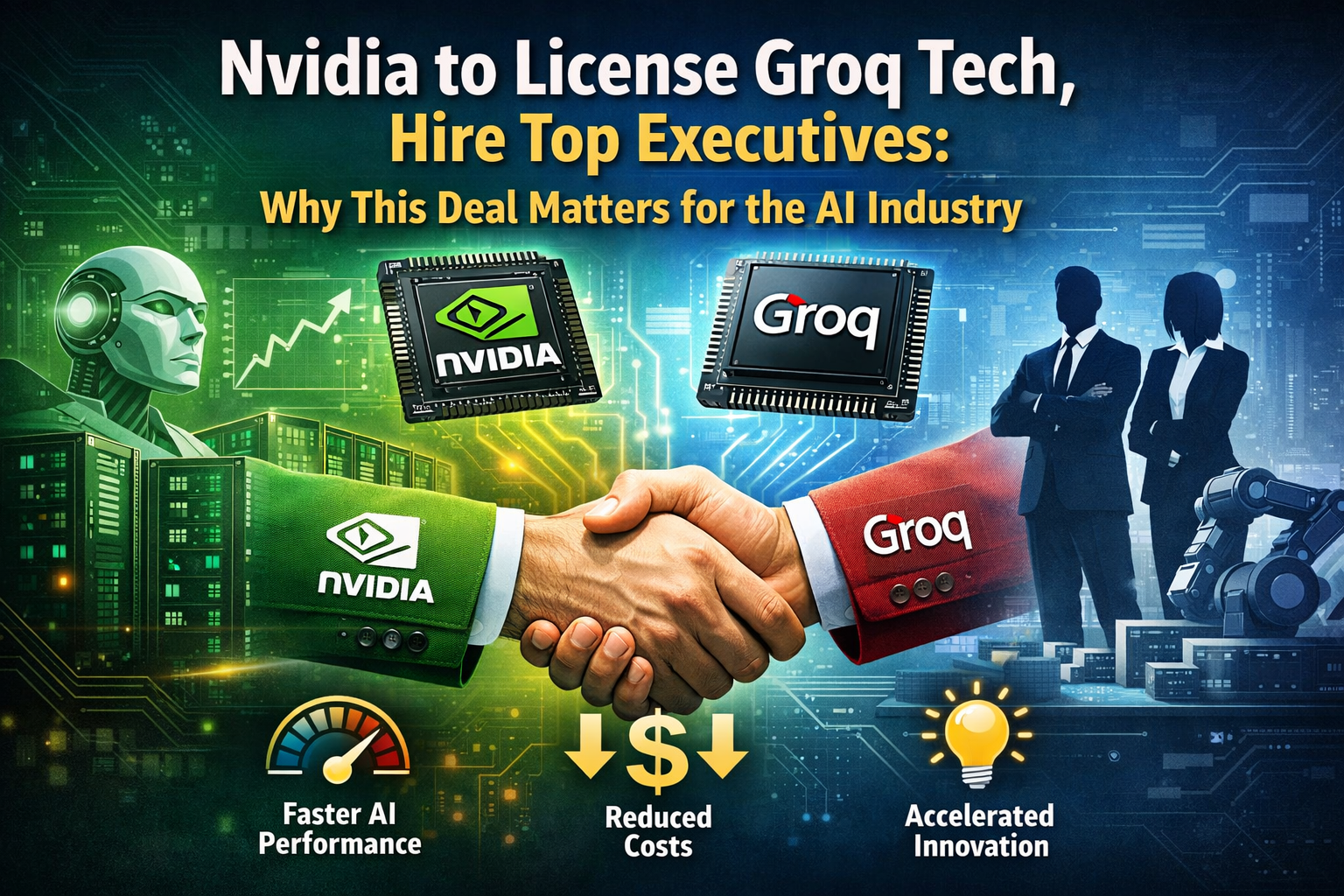
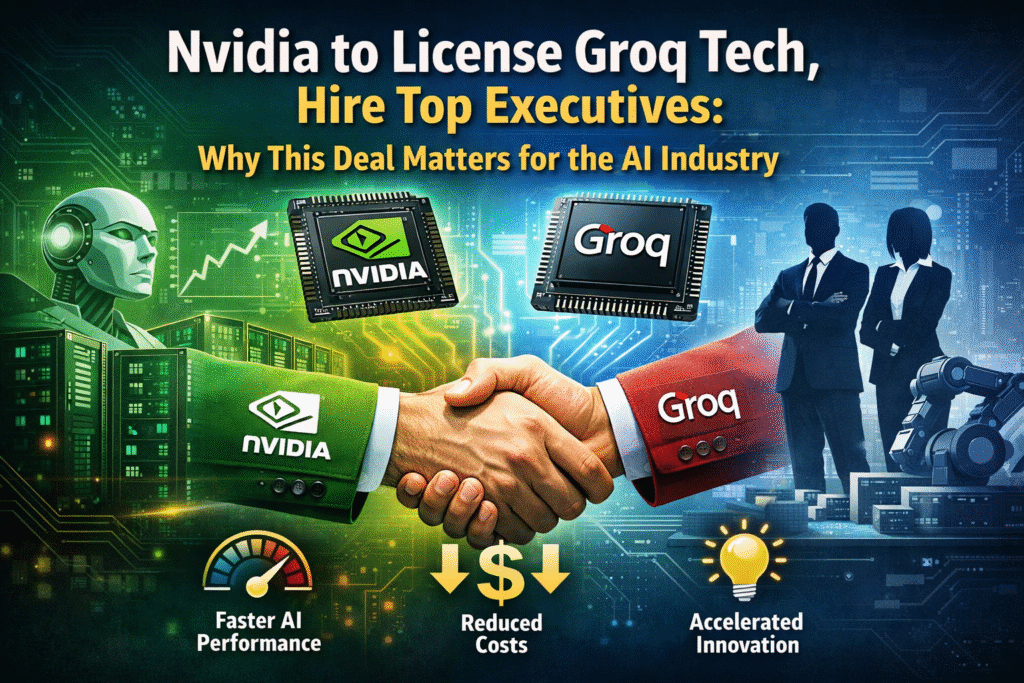
Nvidia Licenses Groq Tech marks a powerful shift in how AI hardware innovation is evolving. Instead of relying only on in-house GPU advancements, Nvidia is tapping external innovation from Groq—a company known for ultra-fast AI inference chips.
This move signals one clear message: the future of AI isn’t just about raw power, but also about speed, efficiency, and talent.
For non-technical readers, think of Groq’s technology as a high-speed express lane for AI tasks. While GPUs are great for training large AI models, Groq specializes in inference—the moment when AI models deliver real-time answers.
Groq’s Language Processing Units (LPUs) are designed to process AI tasks sequentially, reducing delays and improving predictability. In benchmark tests, Groq systems have shown sub-millisecond latency, making them ideal for chatbots, real-time analytics, and AI assistants.
Also Read :- AI Data Center Revive Obsolete Peaker Power Plants
Why Nvidia to License Groq Tech, Hire Top Executives Matters for the AI Industry
When Nvidia Licenses Groq Tech, it gains more than just intellectual property. Nvidia also strengthens its leadership by hiring Groq’s top executives—people who deeply understand next-generation AI workloads.
This strategy helps Nvidia:
- Expand beyond GPU-only solutions
- Compete with custom silicon from Google and Amazon
- Reduce inference bottlenecks in AI data centers
According to industry estimates, AI inference could account for over 60% of AI compute demand by 2027, making this move especially timely.
Real-World Impact and Examples
Cloud providers running AI chat services can benefit from faster responses and lower energy costs. For example, enterprises deploying customer-support AI could see response times drop from seconds to milliseconds.
Developers may also gain access to hybrid architectures that blend Nvidia GPUs with Groq-inspired inference acceleration—offering flexibility at scale.
For deeper technical insight, you can explore:
- Nvidia’s official AI roadmap: https://www.nvidia.com/en-us/ai-data-science/
- Groq’s LPU architecture overview: https://groq.com
Nvidia Licenses Groq Tech is not just a partnership—it’s a strategic power move. By combining elite talent, specialized inference technology, and market dominance, Nvidia is positioning itself for the next phase of AI growth—where speed matters as much as scale.
Groq Technology Explained Simply
Nvidia Licenses Groq Tech to strengthen a critical part of modern AI systems—inference speed. Groq is an AI hardware startup that builds specialized processors called Language Processing Units (LPUs). These chips are designed to execute AI models extremely fast and predictably, especially when delivering real-time responses.
Unlike traditional GPUs, which handle many tasks at once, Groq’s LPUs focus on deterministic execution. This means every AI request follows a clear, step-by-step path, reducing delays and inconsistencies.
How Groq Technology Works (In Simple Terms)
For non-technical readers, imagine GPUs as multi-lane highways—powerful but often congested. Groq’s LPUs are more like high-speed bullet trains, running on a fixed track with no traffic jams.
Groq chips process AI models sequentially, avoiding the overhead that slows down GPUs during inference. According to Groq’s published benchmarks, their systems can deliver responses in under one millisecond, even for large language models.
This predictable speed is exactly why Nvidia saw strategic value in Groq’s approach.
Why Groq Is Valuable for AI Workloads
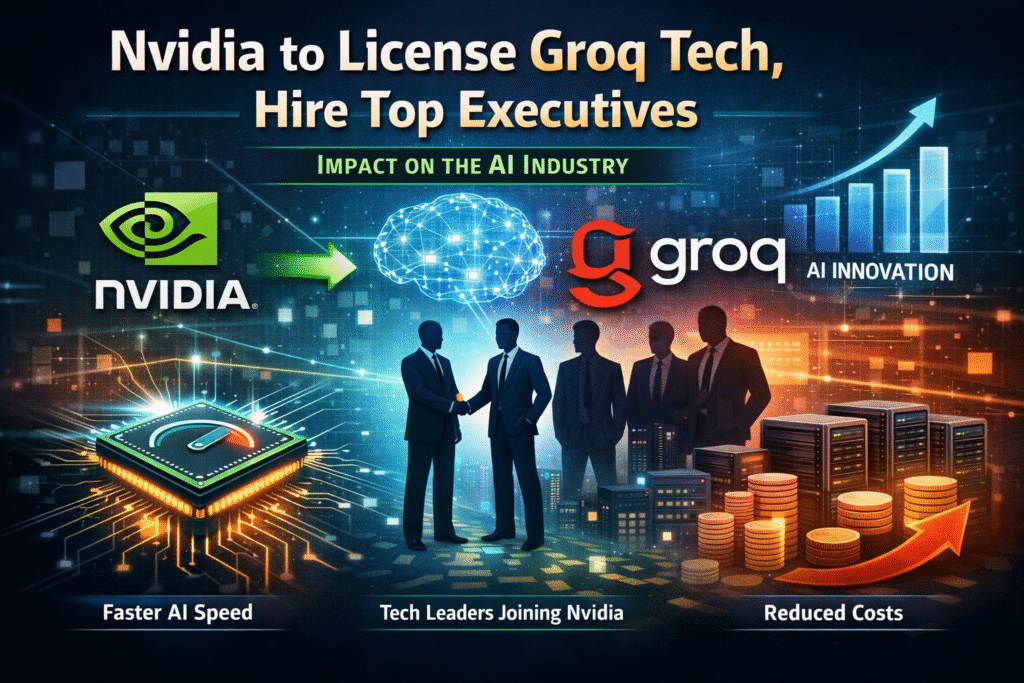
When Nvidia Licenses Groq Tech, it gains a major advantage in the fastest-growing AI segment. Industry analysts estimate that AI inference will represent more than 60% of total AI compute demand by 2027.
Groq technology is especially valuable for:
- AI chatbots and virtual assistants
- Real-time recommendation engines
- Financial trading and fraud detection
- Voice and video AI applications
Lower latency also means lower energy consumption, a growing concern for AI data centers facing rising power costs.
Also Read :- How AI Is Accelerating the Global E-Waste Crisis
Real-World AI Use Cases
For example, an enterprise customer-support chatbot running on Groq-powered inference could reduce response times from seconds to milliseconds—dramatically improving user experience.
Cloud providers and developers benefit from faster scaling without massive infrastructure expansion.
You can explore more technical details here:
- Nvidia AI platforms: https://www.nvidia.com/en-us/ai-data-science/
- Groq LPU architecture: https://groq.com
Key Takeaways
Nvidia Licenses Groq Tech because Groq solves one of AI’s biggest challenges—speed at scale. By combining Nvidia’s GPU dominance with Groq’s inference expertise, the AI ecosystem moves closer to faster, more efficient, and more sustainable intelligence.
Why Nvidia Is Hiring Groq Executives
Nvidia Licenses Groq Tech not only to access advanced AI hardware ideas, but also to secure something equally valuable—experienced leadership. In AI, technology alone is not enough. Execution speed, vision, and decision-making often determine who leads and who follows.
By bringing Groq’s top executives onboard, Nvidia is accelerating innovation without starting from scratch.
Why Nvidia to License Groq Tech, Hire Top Executives Is a Game-Changer for AI
Groq’s leadership team has spent years solving one of AI’s hardest problems: low-latency inference at scale. Their hands-on experience in chip design, software integration, and deployment gives Nvidia immediate insight into real-world AI bottlenecks.
Instead of long internal R&D cycles, Nvidia gains leaders who already understand:
- How inference workloads behave in production
- Where GPUs struggle with latency and predictability
- How to move from prototype to deployment faster
This talent-first approach explains why Nvidia Licenses Groq Tech rather than relying solely on internal development.
Execution Speed as a Competitive Advantage
In today’s AI market, speed matters more than perfection. Companies like Google and Amazon are building custom silicon to optimize AI workloads. Nvidia’s response is faster execution through experienced leadership and proven technology.
Industry data shows that AI deployment timelines have shrunk by over 40% in the past five years, making rapid execution a decisive advantage. Groq executives bring battle-tested processes that help Nvidia move faster from roadmap to revenue.
Strengthening Nvidia’s AI Roadmap
When Nvidia Licenses Groq Tech, it strengthens its AI roadmap in three key ways:
- Diversification beyond GPU-only architectures
- Improved inference performance for real-time AI
- Faster go-to-market strategies for enterprise solutions
This positions Nvidia to dominate not just AI training, but also inference—the segment expected to drive most AI workloads by 2027.
What This Means for the AI Industry
For developers, this move signals better tools and faster AI responses. For enterprises, it means more efficient AI deployments. For competitors, it raises the bar.
Learn more from:
- Nvidia AI strategy: https://www.nvidia.com/en-us/ai-data-science/
- Groq’s technology vision: https://groq.com
Nvidia Licenses Groq Tech because leadership plus speed is the real power move shaping the next phase of AI innovation.
Benefits for Developers and Enterprises
Nvidia Licenses Groq Tech to solve one of AI’s most expensive problems—slow inference. Inference is the moment when an AI model responds to a user query. Whether it’s a chatbot, voice assistant, or recommendation engine, speed directly impacts user experience.
Groq’s technology is built for ultra-low-latency inference, often delivering responses in milliseconds instead of seconds. This is critical as real-time AI applications continue to grow across industries.
Why Faster Inference Matters in Real AI Use
For non-technical readers, faster inference means instant answers. A delay of even one second can reduce user engagement by up to 20%, according to UX studies in AI-driven applications.
By integrating Groq’s approach, Nvidia enhances its ability to support:
- AI chatbots handling millions of requests
- Financial systems detecting fraud in real time
- Autonomous systems that rely on split-second decisions
This performance boost is a key reason Nvidia Licenses Groq Tech instead of relying solely on traditional GPU inference.
How Groq Helps Reduce AI Infrastructure Costs
Speed also brings cost savings. Faster inference means fewer servers are needed to handle the same workload. This directly reduces:
- Hardware expenses
- Energy consumption
- Data center cooling costs
Industry estimates suggest inference workloads can account for up to 70% of AI operating costs in large deployments. Groq’s efficient processing lowers compute waste, allowing companies to scale AI without endlessly expanding infrastructure.
Real-World Examples and Industry Impact
For example, an enterprise running customer-support AI at scale could cut server usage by 30–40% while delivering faster responses. Cloud providers benefit from improved margins, while customers enjoy lower AI service costs.
You can explore related insights here:
- Nvidia AI platforms: https://www.nvidia.com/en-us/ai-data-science/
- Groq technology overview: https://groq.com
Key Takeaways
Nvidia Licenses Groq Tech because faster inference and lower infrastructure costs are no longer optional—they are essential. By combining Nvidia’s ecosystem with Groq’s efficiency-first design, AI becomes faster, cheaper, and more scalable for the next generation of applications.
Risks and Open Questions
While the move appears strategically strong, Nvidia Licenses Groq Tech with several real-world challenges that cannot be ignored. Integrating a new hardware philosophy into an already massive AI ecosystem is complex, especially at Nvidia’s global scale.
Even for a market leader, execution risk is real.
Integration Challenges in AI Hardware
Groq’s inference-first architecture differs fundamentally from traditional GPU-based systems. Merging this approach into Nvidia’s existing CUDA-driven ecosystem may require significant engineering effort.
Developers are heavily invested in Nvidia’s software stack. Any friction—such as retraining teams, rewriting inference pipelines, or adapting tooling—could slow adoption. Industry history shows that hardware innovation often fails not due to performance, but due to poor ecosystem compatibility.
For Nvidia, the challenge lies in making Groq-inspired solutions feel seamless rather than disruptive.
Software Compatibility and Ecosystem Risks
Another hurdle is software maturity. Groq’s tools, while powerful, are newer and less battle-tested at hyperscale compared to Nvidia’s decades-old ecosystem.
AI enterprises prioritize stability. Even minor integration issues can lead to downtime, higher operational risk, and delayed deployments. This is one reason why Nvidia Licenses Groq Tech cautiously rather than immediately reshaping its core platforms.
Market and Regulatory Uncertainties
Beyond technology, market and regulatory pressure adds another layer of risk. Governments worldwide are closely watching AI infrastructure concentration, data-center energy usage, and competition dynamics.
Large licensing deals and executive hiring could attract scrutiny from regulators concerned about:
- Market dominance in AI hardware
- Fair competition and innovation access
- Energy consumption and environmental impact
As AI becomes critical infrastructure, regulatory oversight is expected to increase through 2026 and beyond.
Nvidia Licenses Groq Tech as a bold step forward—but not without challenges. Integration complexity, ecosystem alignment, and regulatory uncertainty will test Nvidia’s execution capabilities.
If handled well, these risks become manageable trade-offs for long-term leadership. If mishandled, they could slow adoption. The outcome depends not just on technology—but on strategy, coordination, and regulatory navigation.
Learn more:
- Nvidia AI ecosystem: https://www.nvidia.com/en-us/ai-data-science/
- Groq platform overview: https://groq.com
In AI’s next phase, success belongs to those who can innovate and integrate at scale.
Nvidia Licenses Groq Tech because the AI market has entered a new phase—one where inference speed, efficiency, and execution matter as much as raw compute power. AI is no longer confined to training massive models; it now powers real-time products used by millions every day.
Groq’s inference-first approach directly addresses this shift. Combined with Nvidia’s scale, ecosystem, and global reach, the deal signals a move toward end-to-end AI dominance, from training to real-time deployment.
Strategic Value Beyond Hardware
This deal is not just about chips. When Nvidia brings in Groq’s technology and leadership expertise, it gains:
- Faster innovation cycles
- Proven inference know-how
- Reduced time-to-market for AI solutions
Industry analysts estimate that AI inference workloads will outpace training demand by nearly 2× within the next three years, making this partnership strategically timed rather than reactive.
This explains why Nvidia Licenses Groq Tech instead of building everything internally.
Long-Term Outlook for Nvidia and AI
Looking ahead, the long-term impact of this deal could be substantial. Nvidia is positioning itself not only as the backbone of AI training, but also as the default platform for real-time AI applications.
In the coming years, we can expect:
- Hybrid AI architectures combining GPUs with inference-optimized designs
- Lower AI operating costs for enterprises
- Faster AI adoption across industries like healthcare, finance, and retail
As regulatory scrutiny and energy costs rise, efficiency-driven AI solutions will gain priority—strengthening the value of this move.
What Enterprises and Developers Should Expect
For developers, this means better performance without rewriting entire systems. For enterprises, it means scalable AI with predictable costs and latency.
External insights:
- Nvidia AI platforms: https://www.nvidia.com/en-us/ai-data-science/
- Groq technology overview: https://groq.com
Final Takeaway
Nvidia Licenses Groq Tech because the future of AI belongs to platforms that balance power, speed, and efficiency. This deal is not a short-term optimization—it’s a long-term strategy that could redefine how AI is built, deployed, and scaled over the next decade.