
Artificial intelligence is no longer a futuristic concept—it’s part of our everyday digital experience.
From chatbots handling customer service queries to AI tools generating code, marketing copy, and data insights, adoption has accelerated rapidly.
According to industry reports, over 75% of businesses are now experimenting with or actively using AI in at least one department.
Tools like OpenAI models and automation platforms from Microsoft and Google have made AI more accessible than ever, even for non-technical users.
As AI becomes embedded in workflows, professionals are constantly searching for smarter, faster, and more integrated solutions.
That’s one of the reasons people are increasingly asking, What is bind AI? Businesses want tools that not only generate responses but also connect different systems, automate repetitive processes, and streamline collaboration.
Developers are looking for AI solutions that can integrate with their codebases. Startups want cost-efficient automation.
In this crowded AI ecosystem, new platforms emerge promising better productivity and seamless integration—naturally sparking curiosity around questions like, What is bind AI?
Another reason behind the growing interest in What is bind AI? is the shift from standalone AI tools to connected AI systems.
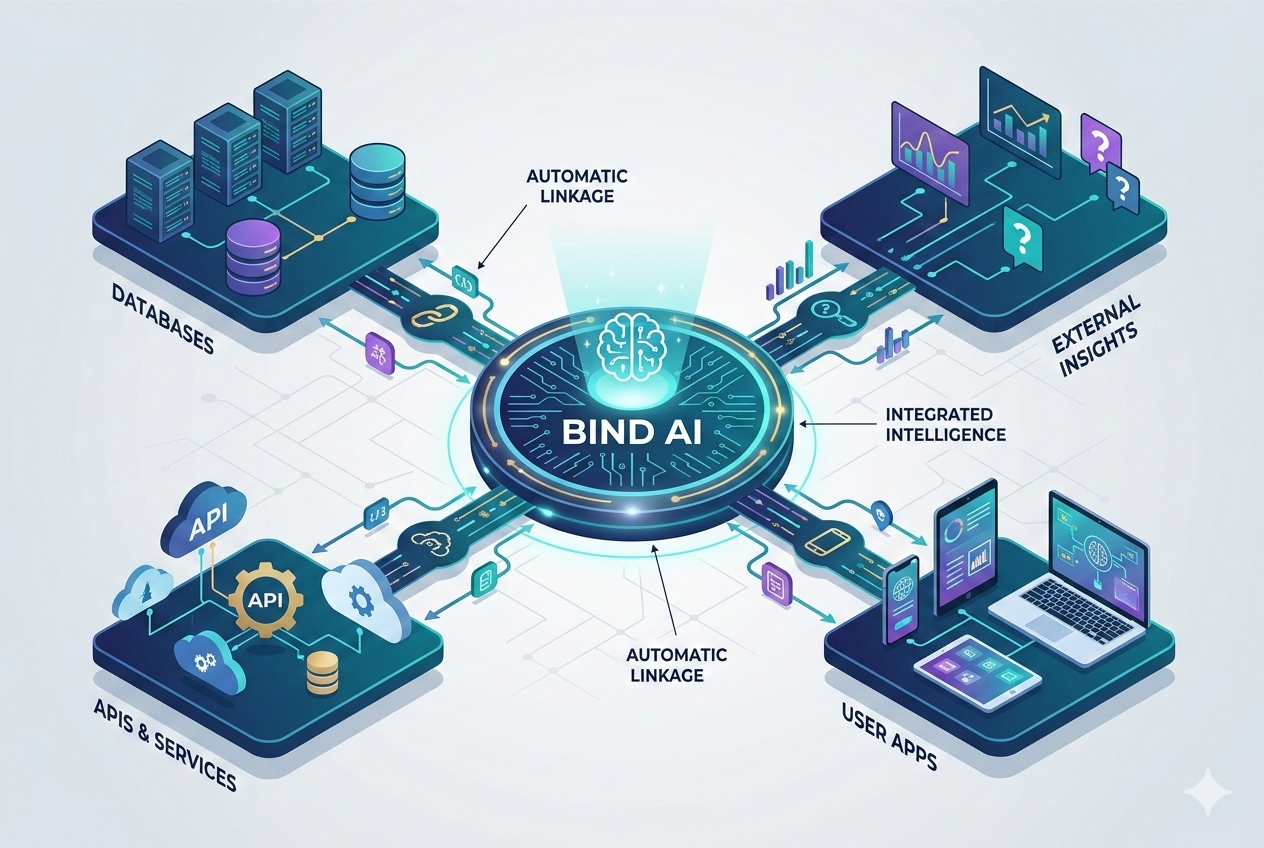
Modern organizations don’t just need an AI chatbot; they need AI that can “bind” workflows together—linking CRMs, databases, communication tools, and analytics dashboards.
For example, instead of manually transferring customer data from emails into a CRM, AI-powered automation can handle it instantly, reducing errors and saving hours each week.
The purpose of this article is simple: to clearly explain What is bind AI?, how it fits into the expanding AI landscape, and why it’s gaining attention.
Whether you’re a business owner, developer, or simply curious about emerging AI platforms, this guide will break it down in practical, easy-to-understand terms—without the technical jargon.
Also Read: What is Wren AI Used For? A Simple Guide for Beginners
Definition of Bind AI
At its core, What is bind AI? Simply put, Bind AI is an artificial intelligence platform designed to connect (“bind”) different tools, systems, or workflows together and automate tasks between them.
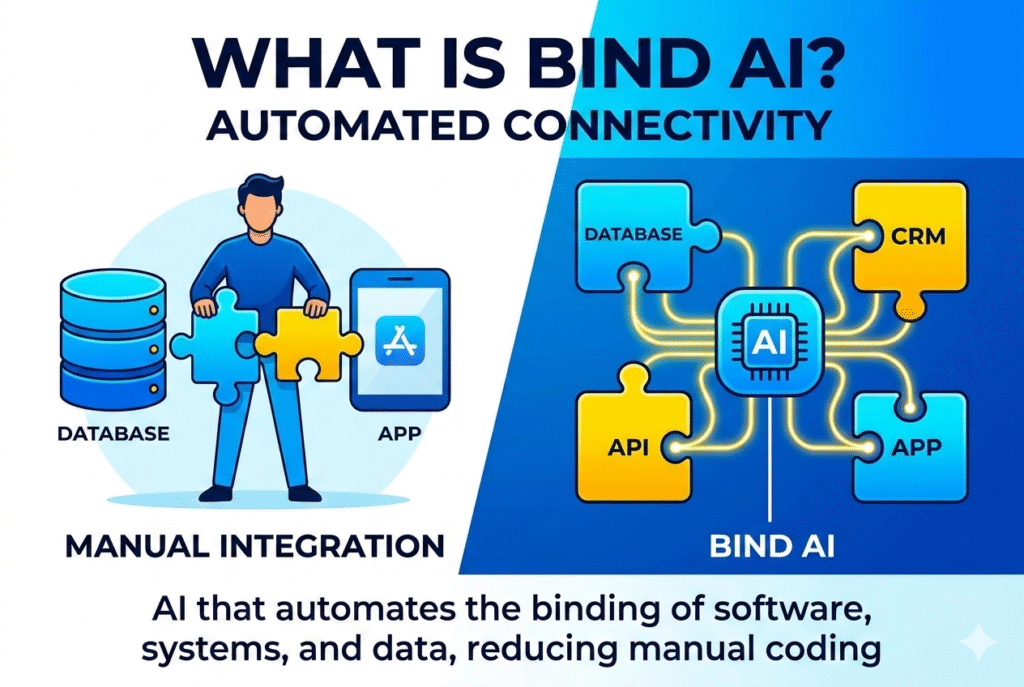
In beginner-friendly language, it acts like a smart digital assistant that not only understands instructions but also links multiple apps or processes so they work smoothly as one system.
Instead of using five separate tools manually, Bind AI helps them communicate and perform actions automatically.
The core concept behind Bind AI revolves around integration and intelligent automation.
Traditional AI tools often focus on a single function—like generating text, analyzing data, or answering questions. Bind AI, however, aims to go a step further by combining AI decision-making with workflow connectivity.
Think of it as a bridge between platforms. For example, when a customer fills out a form on a website, Bind AI could automatically analyze the information, categorize the request, update a CRM system, and notify the sales team—all without human intervention.
This approach aligns with the growing demand for connected automation. Research shows that employees spend nearly 30% of their workweek on repetitive administrative tasks.
Businesses lose time switching between tools, copying data, or managing disconnected systems. That’s the exact problem Bind AI aims to solve.
Instead of isolated AI features, companies need unified systems that reduce manual effort and improve efficiency.
So when people ask, What is bind AI?, they are often looking for a solution that simplifies complexity.
In fast-growing startups or even large enterprises, managing multiple apps—project management tools, communication platforms, data dashboards—can become overwhelming.
Bind AI’s goal is to reduce that friction by intelligently linking these systems and automating routine processes.
In short, What is bind AI? It’s an AI-powered connector designed to eliminate repetitive work, streamline workflows, and help businesses operate more efficiently in a digital-first world.
Also Read: What is Imagga Used For?
Key Features of Bind AI
One of the biggest reasons people ask, What is bind AI?, is because of its powerful automation capabilities.
In today’s fast-paced digital environment, businesses rely on multiple tools—CRMs, email platforms, analytics dashboards, and project management software.
Manually moving data between these systems is time-consuming and prone to errors. Bind AI focuses on automating these repetitive workflows.
For example, when a lead fills out a website form, the system can automatically validate the data, update the CRM, assign the lead to a sales rep, and send a follow-up email—all within seconds.
Studies show automation can reduce operational costs by up to 30%, making this feature highly valuable for growing companies.
Another core strength lies in AI-driven decision-making. Instead of just following fixed rules, Bind AI can analyze patterns and make intelligent choices based on data.
For instance, it might prioritize customer inquiries based on urgency, flag unusual transactions for review, or recommend actions based on previous performance metrics.
This kind of intelligent processing mirrors how advanced AI systems from companies like Google and Microsoft enhance productivity tools with predictive insights. The goal is not just automation—but smarter automation.
Integration is also central to understanding What is bind AI? Modern businesses use dozens of software tools, and disconnected systems create workflow bottlenecks.
Bind AI is designed to integrate with multiple platforms, allowing seamless data exchange between applications.
Whether it’s syncing marketing data with analytics tools or connecting customer support platforms to internal dashboards, integration reduces manual effort and improves accuracy.
Finally, a user-friendly interface makes the platform accessible even to non-technical users.
Many AI tools require coding knowledge, but Bind AI emphasizes intuitive dashboards, drag-and-drop workflows, and clear configuration steps.
This lowers the learning curve and enables teams to implement automation quickly without heavy IT involvement.
More Read: Is Photor AI Free? What You Can (and Can’t) Do Without a Credit Card
How Bind AI Works
When people search What is bind AI?, they’re often curious about the technology working behind the scenes.
At a basic level, Bind AI operates using artificial intelligence models that can analyze data, recognize patterns, and trigger automated actions.
It combines rule-based automation (if X happens, do Y) with adaptive AI models that improve over time.
Think of it as a smart engine that not only follows instructions but also learns from outcomes to refine future decisions.
The role of machine learning is central to this process. Machine learning allows the system to study historical data—such as customer interactions, sales trends, or operational workflows—and identify patterns.
For example, if certain types of customer inquiries frequently result in refunds, the AI can flag similar cases faster in the future.
According to industry research, organizations using machine learning-driven automation report up to 40% faster decision-making compared to manual processes.
Companies like Google and Microsoft use similar AI frameworks in their cloud platforms to power predictive analytics and workflow optimization.
Bind AI applies these concepts in a more workflow-focused environment.
Data processing is another key component. Bind AI collects, organizes, and interprets structured data (like spreadsheets or CRM entries) and unstructured data (such as emails or text messages).
It processes this information in real time, enabling instant actions—like sending alerts, updating dashboards, or assigning tasks automatically.
This reduces delays and human error, which are common in manual data handling.
From a workflow perspective, the system usually follows three steps: input, analysis, and action. First, it receives data from connected platforms.
Second, it analyzes that data using predefined rules and machine learning models. Finally, it executes automated tasks based on the results.
Benefits of Using Bind AI
One of the clearest reasons businesses explore What is bind AI? is the measurable impact it can have on daily operations. At the most basic level, it saves time and effort.
Employees often spend hours each week switching between tools, copying data, sending follow-up emails, or updating spreadsheets.
Research suggests knowledge workers spend nearly 25–30% of their time on repetitive administrative tasks.
By automating these workflows, Bind AI allows teams to redirect that time toward strategic work—like innovation, customer engagement, or revenue growth.
Beyond saving time, Bind AI significantly improves productivity. When processes run automatically and intelligently, tasks are completed faster and with fewer errors.
For example, instead of manually qualifying sales leads, AI can instantly score and categorize them based on predefined criteria.
This means sales teams focus only on high-potential prospects. Companies that implement workflow automation often report productivity increases of 20–40%, depending on the industry.
This productivity boost is a major reason people ask, What is bind AI?—they’re searching for smarter ways to work, not just harder ones.
Cost reduction is another powerful benefit. Manual errors, delayed responses, and inefficient workflows can quietly drain company resources.
Automation reduces labor-intensive tasks and minimizes costly mistakes.
For small and mid-sized businesses especially, lowering operational costs without hiring additional staff can make a significant difference in profitability.
Finally, scalability is where Bind AI truly stands out. As a business grows, the volume of data, customers, and tasks increases.
Without automation, this growth often requires expanding teams and infrastructure. Bind AI allows companies to handle larger workloads without proportionally increasing expenses.
For example, an e-commerce store processing 100 orders per day can scale to 1,000 orders with automated workflows handling inventory updates, confirmations, and reporting.
Use Cases of Bind AI
When businesses explore What is bind AI?, they often want to understand how it applies to real-world scenarios.
One of its strongest applications is business process automation. Companies today manage dozens of repetitive tasks—invoice approvals, employee onboarding workflows, lead routing, and order processing.
Bind AI can automate these end-to-end processes.
For example, when a purchase order is submitted, the system can automatically verify details, notify the appropriate manager, update accounting software, and store documentation in the cloud.
This reduces manual delays and ensures consistency across operations.
Customer support systems are another powerful use case. Modern customers expect fast responses—often within minutes.
AI-driven workflows can categorize incoming queries, prioritize urgent cases, and even generate instant responses for common questions.
Studies show that businesses using AI-powered chat systems can reduce response times by up to 60%.
Instead of replacing human agents, Bind AI can support them by handling repetitive inquiries and routing complex issues to the right department.
This improves both efficiency and customer satisfaction.
Data analysis and insights are equally important. Many companies collect massive amounts of data but struggle to turn it into actionable insights.
Bind AI can process sales numbers, website traffic, and customer behavior patterns in real time, highlighting trends and anomalies.
For instance, if a sudden drop in conversions occurs, the system can flag the issue and generate a performance summary.
This helps decision-makers act quickly rather than relying on delayed manual reports. That’s another reason people ask, What is bind AI?—they want smarter, faster data-driven decisions.
Content creation is also emerging as a practical application. From drafting emails to generating marketing copy or summarizing reports, AI can assist teams in producing content faster while maintaining quality.
For growing businesses with limited resources, this can significantly improve marketing output without increasing headcount.
Pros and Cons
One of the biggest advantages is efficiency. Bind AI automates repetitive workflows, reducing manual errors and saving significant time.
Businesses that implement automation tools often report productivity gains of 20–40%, especially in areas like operations and customer support.
Another key benefit is improved decision-making. Because the system analyzes data in real time, it can provide insights and trigger actions faster than manual processes.
This allows teams to respond quickly to customer needs, sales opportunities, or operational issues.
Scalability is another major advantage. As businesses grow, workloads increase—but automation ensures that processes can expand without a proportional increase in staffing costs.
For startups and small businesses, this can be a game-changer. That’s why many decision-makers researching What is bind AI? see it as a long-term growth solution rather than just a short-term tool.
However, no AI system is perfect. One limitation is data dependency. Bind AI’s performance depends heavily on the quality and structure of the data it receives.
Poor or inconsistent data can lead to inaccurate outputs. There can also be integration challenges if existing systems are outdated or lack API compatibility.
Another consideration is the learning curve. While many platforms aim to be user-friendly, teams may still require training to design workflows effectively.
Over-automation can also be risky—some processes still benefit from human oversight, especially in sensitive areas like finance or compliance.
Before adopting Bind AI, businesses should assess their current workflows and identify clear automation goals. It’s essential to calculate potential ROI—considering time saved, error reduction, and operational efficiency.
Security and data privacy should also be carefully reviewed, particularly if handling customer information.
Conclusion
In summary, What is bind AI? is an AI-powered platform designed to connect and automate workflows across multiple tools and systems.
It combines intelligent automation, AI-driven decision-making, and seamless integration to streamline business processes.
From automating repetitive tasks to providing actionable insights and supporting content creation, Bind AI helps organizations save time, reduce costs, and scale efficiently.
Its user-friendly interface also makes it accessible for teams without advanced technical skills, bridging the gap between complex AI capabilities and practical business needs.
Businesses of all sizes can benefit from Bind AI, but it’s particularly useful for those managing multiple platforms, handling large volumes of data, or dealing with repetitive operational tasks.
Startups can leverage it to scale processes without increasing headcount, enterprises can improve efficiency across departments, and customer support teams can enhance responsiveness.
Even marketing and content teams can use it to automate drafts, reports, and analysis, freeing employees to focus on higher-value work.
Essentially, anyone looking to reduce manual effort and improve workflow efficiency should consider using Bind AI.
Looking ahead, the future outlook for Bind AI is promising.
As AI technologies continue to evolve, we can expect more advanced features, such as predictive analytics, deeper integrations, and even greater personalization of workflows.
With the increasing demand for AI-driven efficiency, platforms like Bind AI are likely to become central tools in the digital workplace, helping businesses adapt to faster, smarter, and more automated operations. In essence, What is bind AI? represents a step toward the next generation of intelligent, connected business automation.