Businesses today generate massive amounts of data — from sales transactions and website traffic to customer behavior and product usage.
The challenge isn’t collecting data anymore; it’s understanding it quickly. That’s where Wren AI comes in.
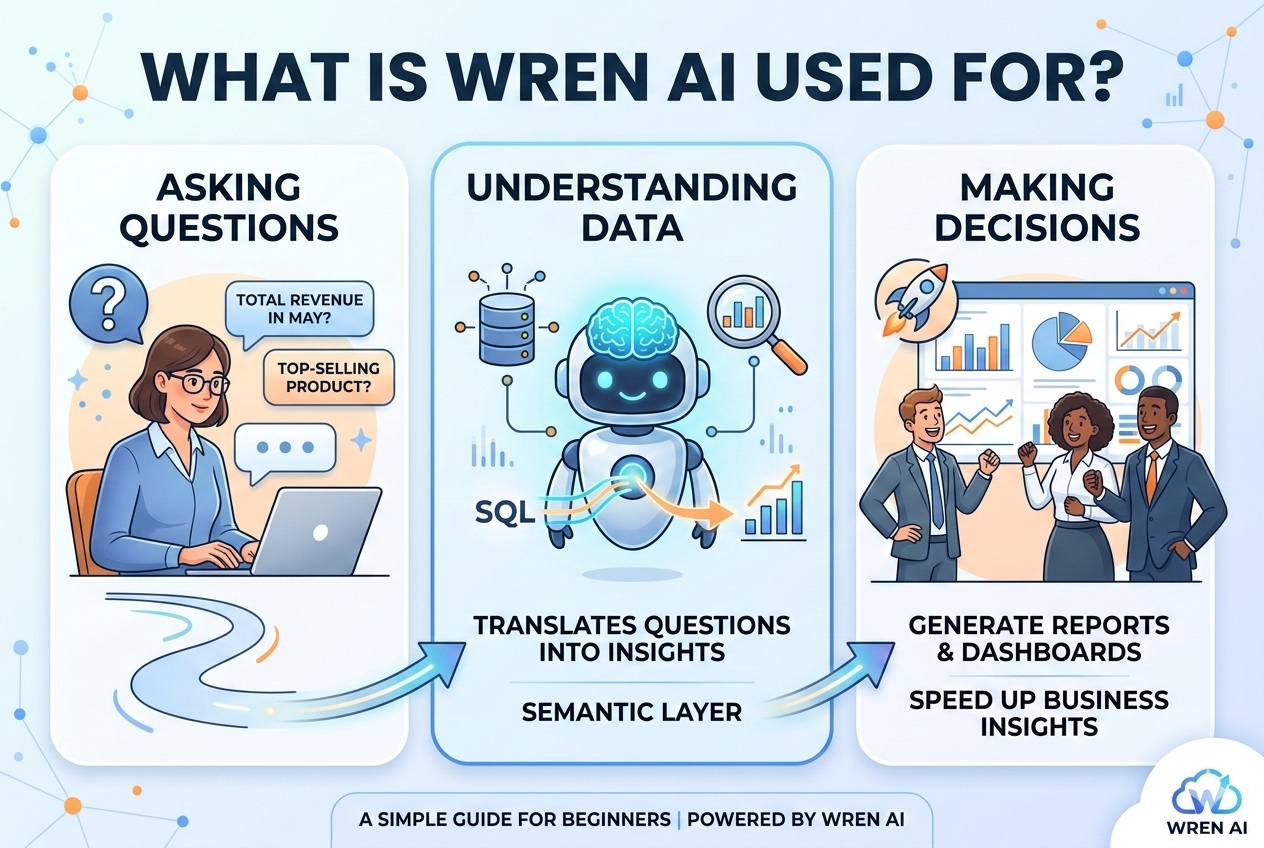
If you’re wondering, What is Wren AI used for? — it’s primarily designed to help teams interact with their data using plain English instead of complex coding.
Wren AI is a conversational business intelligence (BI) platform that allows users to ask questions like, “What were our top-selling products last quarter?” and instantly receive structured insights.
According to industry reports, over 60% of business leaders say they struggle to extract timely insights from their data due to technical barriers.
Tools like Wren AI aim to close that gap by making analytics accessible to everyone — not just data analysts.
At the heart of Wren AI is conversational analytics. Instead of building dashboards manually or writing SQL queries, users simply type their questions.
The system interprets intent, understands the database schema, and generates accurate SQL queries behind the scenes.
For example, a marketing manager can ask, “Which campaign generated the highest ROI in 2025?” and Wren AI automatically translates that into a structured query, pulls the relevant data, and presents it in chart or table format.
This dramatically reduces the time spent waiting for data teams.
So, What is Wren AI used for? It’s used to eliminate bottlenecks in data analysis, empower non-technical teams, and accelerate decision-making.
Businesses adopting AI-powered BI tools report faster reporting cycles and improved productivity.
In fact, companies leveraging AI in analytics have seen decision-making speed improve by up to 30%, according to market research on AI adoption trends.
Another reason organizations are embracing these tools is scalability. As companies grow, data complexity increases.
AI-powered BI solutions like Wren AI help teams stay agile without constantly expanding their analytics workforce.
Ultimately, when asking What is Wren AI used for?, the answer is simple: it transforms raw data into instant, understandable insights — helping businesses make smarter decisions, faster.
Also Read: What is Imagga Used For?
What is Wren AI Used For in Everyday Business Operations?
In many organizations, getting a simple answer from company data can take hours—or even days.
A manager requests a report, the data team writes SQL queries, reviews the output, and then shares the results. This traditional workflow slows decision-making.
So, What is Wren AI used for? It’s used to remove that delay by giving teams instant answers directly from their data.
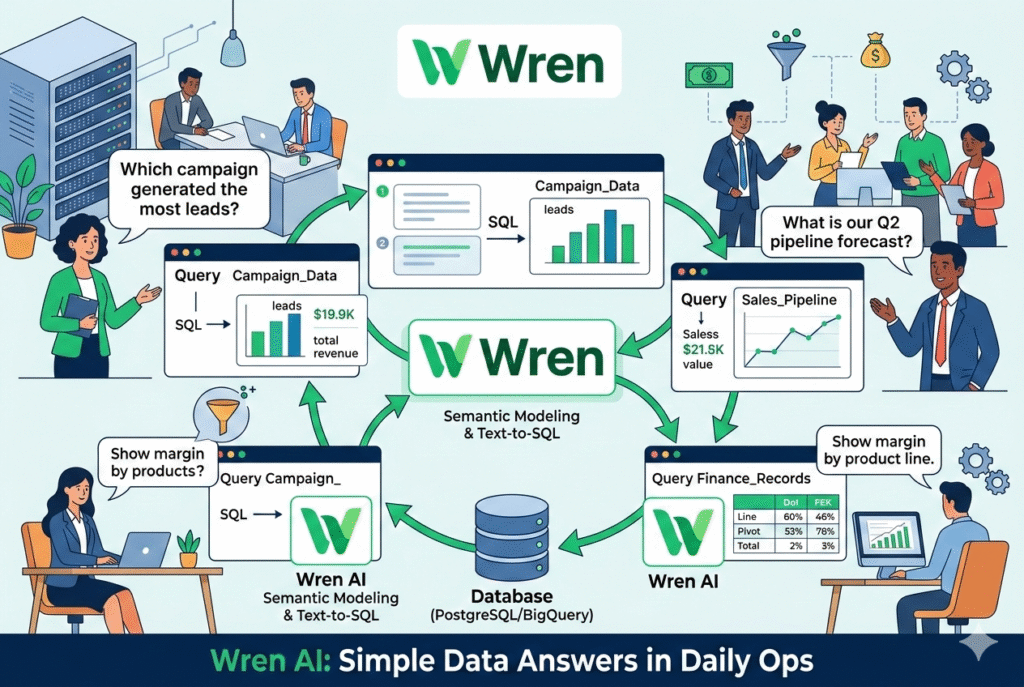
Instead of waiting in a reporting queue, users can simply type a question in plain English.
For example: “What were last month’s sales?” Within seconds, Wren AI interprets the request, converts it into a structured SQL query, pulls data from connected databases, and presents the results in a clear table or chart.
No technical expertise required. According to industry research, data professionals spend nearly 40–50% of their time answering ad-hoc business questions. Tools like Wren AI significantly reduce this repetitive workload.
Another key reason businesses ask What is Wren AI used for? is its ability to replace manual SQL queries. Writing SQL requires knowledge of database structures, joins, filters, and aggregations.
For non-technical teams, this creates dependency. Wren AI automates the process by translating natural language into accurate SQL behind the scenes. This not only saves time but also reduces human error in query writing.
Reducing dependency on data teams is a major operational benefit. When marketing, sales, or operations teams can access insights independently, data analysts can focus on higher-value tasks like modeling, forecasting, and strategic analysis.
McKinsey reports that organizations using AI-driven analytics tools can improve productivity by up to 20–30% due to faster access to insights.
So again, What is Wren AI used for? It’s used to democratize data access across departments.
Instead of data being locked behind technical barriers, it becomes a shared resource that anyone can explore safely and efficiently.
Imagine a sales director preparing for a monthly meeting. Instead of requesting a report days in advance, they simply ask, “What were last month’s sales by region?” and get a breakdown instantly.
That speed can make the difference between reactive decisions and proactive strategy.
More Read: Can You Use AI to Predict Bets? The Ultimate Guide for Smart Bettors
What is Wren AI Used For in Marketing and Sales Teams?
Marketing and sales teams live and breathe data. From tracking ad performance to forecasting revenue, every decision depends on accurate insights.
This naturally leads to the question: What is Wren AI used for? In marketing and sales environments, Wren AI is used to turn complex datasets into instant, actionable insights—without requiring technical expertise.

Take campaign performance analysis as an example. Marketers often run multiple campaigns across channels like Google Ads, email, and social media.
Measuring ROI, cost per acquisition (CPA), and conversion rates usually requires pulling data from several sources and writing SQL queries.
With Wren AI, a marketer can simply ask, “Which campaign had the highest ROI in Q1?” and receive a clear breakdown within seconds.
Considering that companies waste up to 26% of marketing budgets on underperforming channels (according to industry studies), faster insight means faster optimization.
Customer segmentation is another powerful use case. Businesses rely on segmentation to personalize messaging and improve conversion rates.
Instead of manually filtering datasets, a team member could ask, “Show customers who purchased more than three times in the last six months.” Wren AI translates that into SQL automatically and delivers a ready-to-use segment.
Personalized campaigns have been shown to increase revenue by 10–15%, making this capability highly valuable.
When leaders ask, What is Wren AI used for? they’re often thinking about revenue growth.
Sales forecasting becomes more dynamic when teams can instantly analyze historical trends, seasonal patterns, and pipeline data.
For example, asking, “What is the projected revenue for next quarter based on current pipeline?” can generate immediate data-backed projections, helping teams adjust strategy early.
Funnel tracking and revenue insights are equally critical. Sales teams can explore drop-off points by asking, “Where are prospects leaving the funnel?” Instead of static dashboards, they get interactive answers.
So again, What is Wren AI used for? It’s used to empower marketing and sales teams with real-time intelligence—helping them optimize campaigns, understand customers, forecast accurately, and ultimately drive revenue growth with confidence.
More Read: Is Github Copilot Free? Full Pricing & Eligibility Guide (2026)
What is Wren AI Used For in Product and Growth Teams?
For product and growth teams, data isn’t just numbers—it’s a roadmap for building better experiences.
Every click, session, and interaction tells a story. So, What is Wren AI used for? In product environments, it’s used to uncover insights about how users interact with features, where they drop off, and what drives long-term engagement.
Feature usage analysis is one of the most common applications.
Product managers often need answers like, “How many users tried the new dashboard feature in the last 30 days?” Traditionally, this would require event tracking analysis and SQL queries across multiple tables.
With Wren AI, the question can be asked in plain language, and the system generates the query automatically.
This matters because studies show that nearly 80% of product features are rarely or never used. Identifying underperforming features early helps teams prioritize improvements or reallocations.
User behavior tracking becomes much more agile with conversational analytics.
Instead of digging through dashboards, a growth lead can ask, “What actions do users take before upgrading?” or “Which user segment has the highest session frequency?” These insights help refine onboarding flows and optimize the user journey.
Companies that actively analyze behavioral data can improve conversion rates by up to 20%, according to product analytics benchmarks.
Another big reason teams explore What is Wren AI used for? is retention and churn analysis.
Retaining customers is often five times cheaper than acquiring new ones.
With Wren AI, teams can ask, “What percentage of users churned after 60 days?” or “Which cohort has the highest retention rate?” Instant answers allow faster experimentation and targeted re-engagement campaigns.
A/B testing insights are equally powerful. Instead of manually comparing experiment results, teams can query, “Which variation increased sign-ups the most?” and receive statistically relevant comparisons quickly.
So again, What is Wren AI used for? It’s used to transform raw product data into clear, immediate insights—helping teams ship smarter features, reduce churn, and continuously optimize growth strategies with confidence.
More Read: How to Use Dall-e 2: A Beginner’s Step-by-Step Guide
What is Wren AI Used For in Executive Decision-Making?
In fast-moving organizations, leadership decisions depend on timely and accurate data. Waiting days for reports is no longer practical.
That’s why many executives are asking, What is Wren AI used for? At the leadership level, it’s used to access real-time KPIs, streamline reporting, and support smarter strategic planning.
Real-time KPI tracking is one of its most valuable applications. Executives often monitor metrics such as monthly recurring revenue (MRR), customer acquisition cost (CAC), churn rate, and gross margin.
Instead of relying solely on static dashboards, leaders can ask, “What is our current MRR compared to last month?” and instantly receive updated figures pulled directly from live databases.
Research shows that companies using real-time analytics are 23% more likely to outperform competitors in profitability and decision speed.
Strategic performance dashboards also become more dynamic with conversational analytics.
Rather than navigating multiple BI tools, executives can query specific metrics on demand.
For example, “How did Q1 revenue compare across regions?” or “Which product line delivered the highest margin?” This flexibility allows leaders to dig deeper into trends without depending entirely on technical teams.
Another reason organizations explore What is Wren AI used for? is data-driven planning. Annual and quarterly strategies require accurate forecasting and scenario analysis.
With AI-powered BI tools, executives can test assumptions quickly—like evaluating how a 10% increase in marketing spend could impact pipeline growth.
Faster insight leads to more confident planning and reduced risk.
Board-level reporting is also significantly improved. Preparing board presentations traditionally involves manual data gathering and validation.
With Wren AI, leaders can generate updated summaries in minutes, ensuring that discussions are based on the latest numbers.
So ultimately, What is Wren AI used for? It’s used to give decision-makers immediate access to reliable insights—helping them move from reactive reporting to proactive, data-backed leadership.
More Read: What is Adobe Firefly and Why It Matters in 2026
What is Wren AI Used For Compared to Traditional BI Tools?
For years, dashboards have been the backbone of business intelligence. They display charts, graphs, and KPIs in a structured format.
But as companies generate more complex data, many leaders are asking, What is Wren AI used for? The answer becomes clearer when comparing traditional dashboards with conversational AI.
Dashboards are static by design. They show pre-built metrics based on predefined queries.
If a manager wants a new view—say, revenue filtered by a specific customer segment—they often need a data analyst to modify the report.
Conversational AI, on the other hand, allows users to simply type a question like, “Show revenue from enterprise customers in Q4 by region.”
Wren AI interprets that request, generates the SQL query automatically, and delivers instant results.
This shift moves analytics from fixed reporting to dynamic exploration.
Speed is one of the biggest advantages. Studies suggest that employees spend up to 30% of their time searching for information across systems.
With conversational AI, insights are generated in seconds rather than hours or days. Instead of waiting in a reporting queue, teams can make decisions in real time.
So when businesses ask, What is Wren AI used for? speed and flexibility are at the top of the list.
Flexibility also means users are not limited to pre-defined metrics. They can ask follow-up questions naturally, just like a conversation.
For example: “Why did conversions drop last month?” followed by “Break that down by traffic source.” This layered questioning is difficult to replicate with traditional dashboards.
Perhaps the most transformative benefit is accessibility. Dashboards often require training to interpret correctly, and SQL requires technical expertise.
Conversational AI removes those barriers. Non-technical users—from marketing managers to sales directors—can interact directly with data without writing a single line of code.
Ultimately, What is Wren AI used for? It’s used to make data exploration faster, more flexible, and accessible to everyone—not just analysts.
In a world where quick decisions matter, that accessibility can be a true competitive advantage.
More Read: Is Photor AI Free? What You Can (and Can’t) Do Without a Credit Card
What is Wren AI Used For? Key Benefits at a Glance
In today’s competitive landscape, businesses don’t just need data—they need answers, and they need them fast.
That’s why many organizations are asking, What is Wren AI used for? At its core, it’s used to deliver faster insights, remove technical roadblocks, and help teams make smarter decisions with confidence.
Faster insights are one of the biggest advantages. Traditional reporting workflows often involve submitting a request to a data team, waiting for SQL queries to be written, and reviewing dashboards days later.
With AI-powered analytics, users can simply type a question like, “What were our top-performing products this quarter?” and receive results instantly.
According to industry research, companies that leverage real-time analytics can improve decision-making speed by up to 30%. In fast-moving markets, that speed can directly impact revenue and growth.
Another major benefit answers the question: What is Wren AI used for? It’s used to reduce technical barriers.
Not everyone knows SQL or understands database schemas. In fact, a significant portion of employees rely on analysts to extract even simple insights.
By translating natural language into structured queries automatically, Wren AI empowers non-technical users to explore data independently.
This democratization of data ensures that insights are no longer locked behind specialized skills.
Improved productivity naturally follows.
When data teams are freed from repetitive ad-hoc requests, they can focus on high-impact projects like predictive modeling or strategic forecasting.
Meanwhile, marketing, sales, and operations teams can move faster without bottlenecks.
Studies suggest that automation in analytics can reduce reporting time by up to 40%, allowing teams to reallocate hours toward innovation and execution.
Ultimately, What is Wren AI used for? It’s used to support smarter business decisions.
When leaders have immediate access to reliable insights, they can test assumptions, adjust strategies, and respond to market changes proactively.
Instead of relying on guesswork, decisions are backed by real-time data—creating a culture where insight drives action, not delays.
More Read: Is Openia Chatgpt? Everything You Need to Know
Conclusion: What is Wren AI Used For and Why It Matters in 2026
As we wrap up, it’s helpful to revisit the major ways Wren AI is transforming how organizations interact with data.
So, What is Wren AI used for? In short, it’s used to give businesses instant answers from company data, replace manual SQL queries, and reduce dependency on specialized data teams.
Marketing and sales teams leverage it for campaign analysis, customer segmentation, and sales forecasting.
Product and growth teams use it for feature usage analysis, user behavior tracking, retention insights, and A/B testing evaluation.
At the executive level, Wren AI enables real-time KPI tracking, strategic dashboards, and faster board-level reporting.
The rise of conversational BI is shaping the future of analytics.
Unlike static dashboards, conversational AI allows teams to interact naturally with data, ask follow-up questions, and receive immediate answers.
This approach eliminates technical barriers, accelerates decision-making, and ensures that insights are accessible to all stakeholders—not just analysts.
According to recent research, organizations using conversational BI report up to a 30% faster insight-to-action cycle, giving them a competitive edge in fast-moving markets.
For businesses considering Wren AI, the message is clear: it’s more than just a tool—it’s a strategic enabler.
By democratizing access to data, enhancing productivity, and supporting smarter decisions, Wren AI empowers organizations to act on insights in real time.
Whether you’re looking to optimize marketing campaigns, improve product performance, or give leadership teams immediate access to critical metrics, Wren AI offers a scalable solution that grows with your data needs.
In short, What is Wren AI used for? It’s used to turn raw data into actionable intelligence, making insights faster, easier, and more impactful for every level of your organization.